

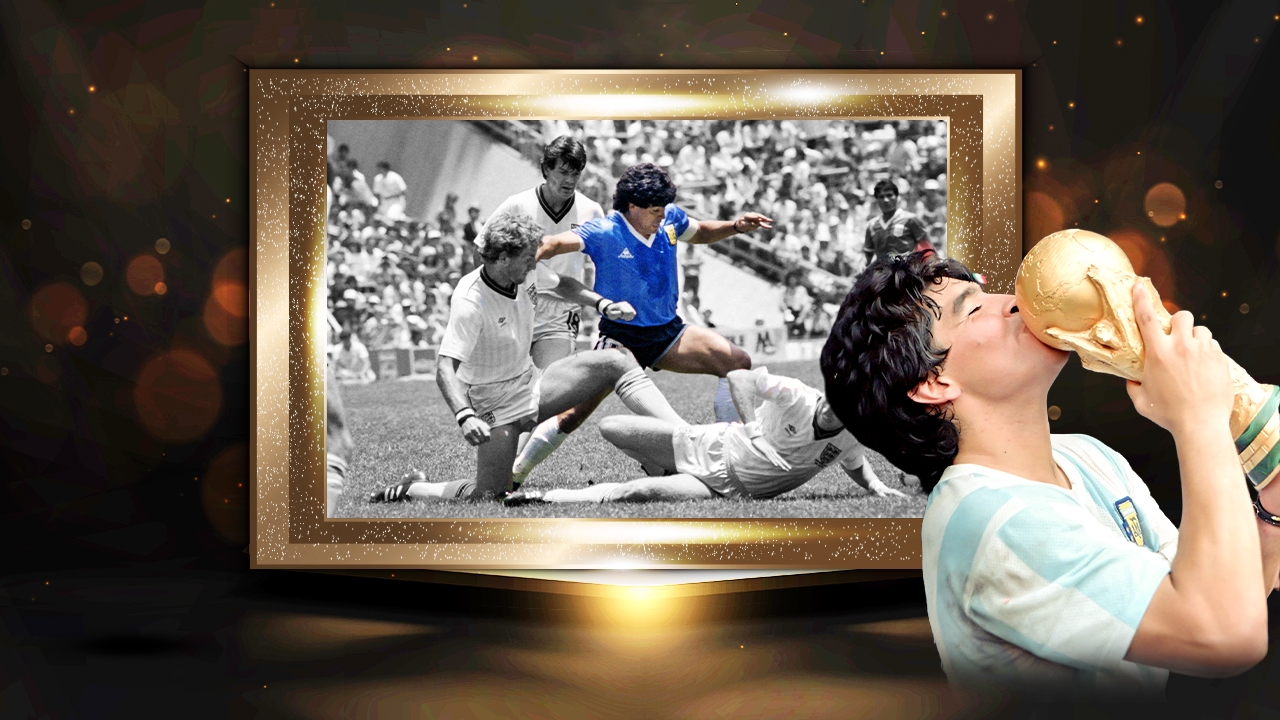
Hall of Fame: Diego Maradona, Argentina's greatest national football star and legendary "Hand of Gods." The story continues in Hall of Fame.
Diego Maradona was not just an attacking midfielder or captain of Argentina's national team but also a symbol of hope and pride for the entire country. His exceptional ball control, sharp vision on the field, and ability to change games at critical moments made him a lasting legend.
When speaking of World Cup memories involving Diego Maradona, the 1986 tournament in Mexico immediately comes to mind. He was not only a key player but also the captain who led Argentina through the group stage with ease. The most memorable moment came in the quarterfinal against England.
In that match, a pivotal moment occurred in the 51st minute when Argentina took a 1-0 lead through a goal by Maradona using his hand to direct the ball into the net. The referee missed the handball, and since there was no VAR then, this became known as the "Hand of Gods." But the unforgettable moments didn’t end there. Minutes later, Maradona dribbled about 60 yards from his own half, evading England players and the goalkeeper, before scoring into an empty net—later called the "Goal of the Century." Although England scored later, Argentina won 2-1. The first goal sparked controversy, while the second was a display of Maradona’s extraordinary skill, making the match iconic and securing his legendary status in that World Cup. Ultimately, he led Argentina to their second World Cup title.
Although the 1986 World Cup was Maradona’s peak, his journey with the national team didn’t start with immediate success. Initially called to the youth squad, he quickly stood out among his peers with his deft ball skills and bold play on the big stage. This led to his promotion to the senior national team, marking the start of his rise to leadership and global recognition.
At the 1982 World Cup in Spain, Maradona joined the national team at age 21. He began well, scoring twice against Hungary, but was sent off with a red card in the match against Brazil. This World Cup was not particularly memorable for him, as he was tightly marked throughout, which limited his performance and caused frustration.
In the 1990 World Cup, Argentina entered as defending champions, hoping to repeat their success. Despite Maradona’s less-than-ideal fitness and a weaker team compared to 1986, he still led Argentina to the final against West Germany. However, they lost, ending in disappointment for Maradona and his teammates.
Maradona returned to the World Cup in 1994 aiming to redeem the 1990 loss. However, his tournament was cut short when he tested positive for banned substances and was suspended for 15 months from all competitions. He was sent home from the national team camp, ending his international career and creating one of the most talked-about moments in World Cup history.
During his time with Argentina, Maradona played 91 matches and scored 34 goals, winning the 1986 World Cup and the World Player of the Year award that year, and finishing runner-up in 1990. At club level, he appeared in 491 matches, scoring 259 goals. His most notable success was with Napoli, where he led the club to its first-ever Italian league title. Other clubs he played for include Argentinos Juniors, Boca Juniors, Barcelona, and Sevilla.
Though many years have passed, Diego Maradona’s name remains synonymous with football history. His talent, determination, and legendary moments at both club and national levels have made him not just an ordinary player, but a symbol of football that fans worldwide will never forget.