

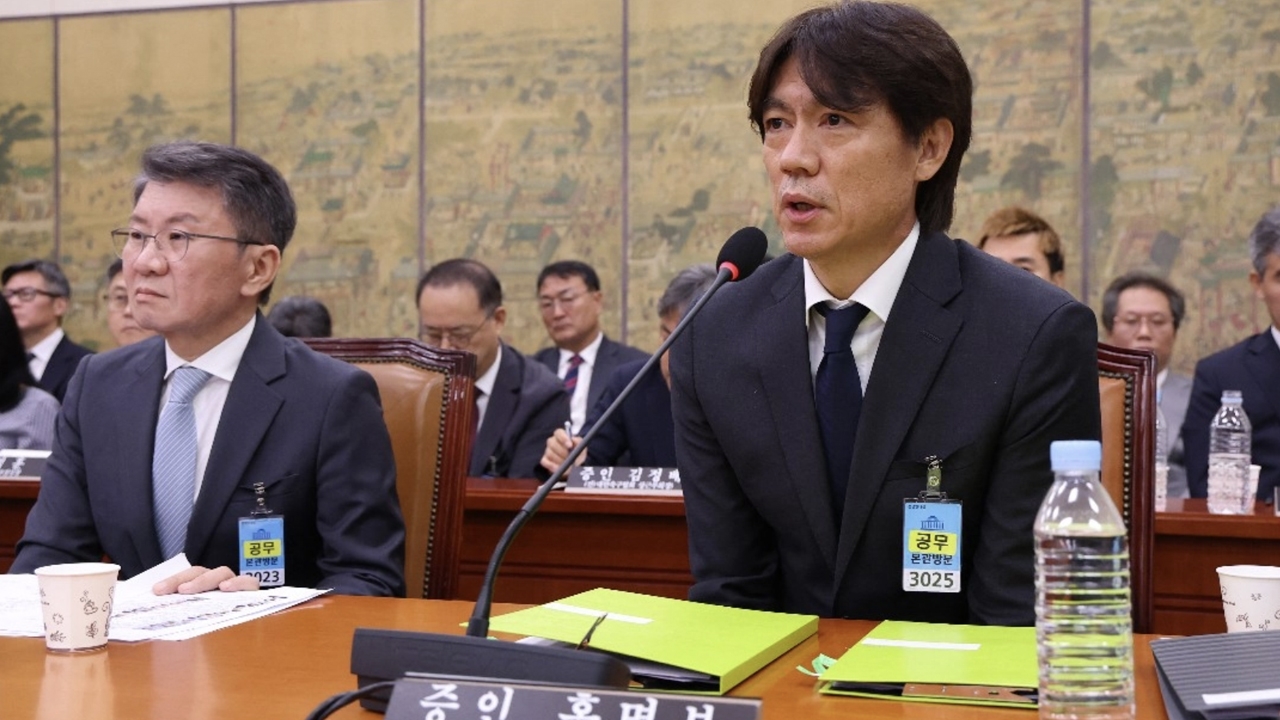
Hong Myung-bo, former South Korean national team coach, is under intense parliamentary investigation following the team's early elimination from the 2026 World Cup.
On 30 Jul 2026 GMT+7, Hong Myung-bo, former head coach of South Korea’s national team and former president of the Korea Football Association (KFA), faced rigorous questioning by the South Korean parliamentary sports committee. The inquiry focused on allegations of non-transparency in the KFA’s management and the reasons behind the national team’s early exit from the 2026 World Cup.
The South Korean National Assembly's sports committee conducted the investigation on 30 Jul 2026 GMT+7 to examine the management of the Korea Football Association (KFA). This followed intense criticism over governance transparency and the disappointing performance of the men's football team in the 2026 World Cup.
Called to testify as witnesses were Chung Mong-gyu, former KFA president who resigned in early July, and Hong Myung-bo, former men’s national team head coach who resigned immediately after the team’s group stage elimination in June. The session was chaired by Lee Jae-jung, a Democratic Party (DP) member of parliament—the ruling party.
The committee stated that the investigation was not solely focused on World Cup results but aimed to review the entire KFA management system, including the process of appointing head coaches and the long-term governance approach for Korean football.
Lee Jae-jung said football has long brought happiness and pride to South Koreans, but recently public trust in the KFA’s transparency has been questioned heavily. The public demands serious organizational reform. At the 2026 World Cup, South Korea finished the group stage with one win and two losses, failing to advance to the round of 32.
Chung apologized to the public and football fans for the national team's performance and the controversies during his tenure. He stated that he had strived to develop Korean football fully but acknowledged that the World Cup outcomes and related issues caused disappointment. He added he would now focus on his business and social work.
Hong Myung-bo apologized to fans and admitted he could not meet performance expectations. The former national team coach affirmed his willingness to clarify all facts known to him and accept responsibility for the outcomes.
A key focus of the inquiry was the 2024 appointment process of Hong Myung-bo as head coach. Previously, the Ministry of Culture, Sports and Tourism had investigated whether the KFA followed proper selection procedures.
A parliamentarian from the People Power Party noted that Hong did not undergo a formal interview but was approached by then-technical director Lee Im-sang at a bakery near his home. When asked if he felt ashamed of the appointment process, Hong said he believed the association had followed all proper steps and denied ever requesting special privileges.
Another issue raised was the allegation that the KFA gave preferential treatment to alumni of Korea University, as Chung Mong-gyu is also an alumnus of this institution.
Chung explained that during his tenure, 25 men’s national team head coaches were appointed, with only one being a Korea University graduate. For the women’s national team, over 20 head coaches were appointed, none of whom graduated from that university. Nonetheless, he acknowledged that this perception had caused public misunderstanding and apologized to society.
Following the World Cup failure, South Korea’s Ministry of Culture, Sports and Tourism established the Korea Football Innovation Committee (K-Football Innovation Committee) to study reform measures for the KFA’s management system and enhance governance in Korean football.
Co-chairing the committee are Park Ji-sung, former South Korean national team captain, and Ryu Seung-min, president of the Korean Olympic Committee and Sports Council. Ryu attended the parliamentary inquiry as an expert witness, while Park did not participate in this session.
This investigation reflects growing pressure on South Korean football following the national team’s underperformance and increasing public calls for serious reform of the KFA’s management. The aim is to restore fan confidence and elevate Korean football in the future.