

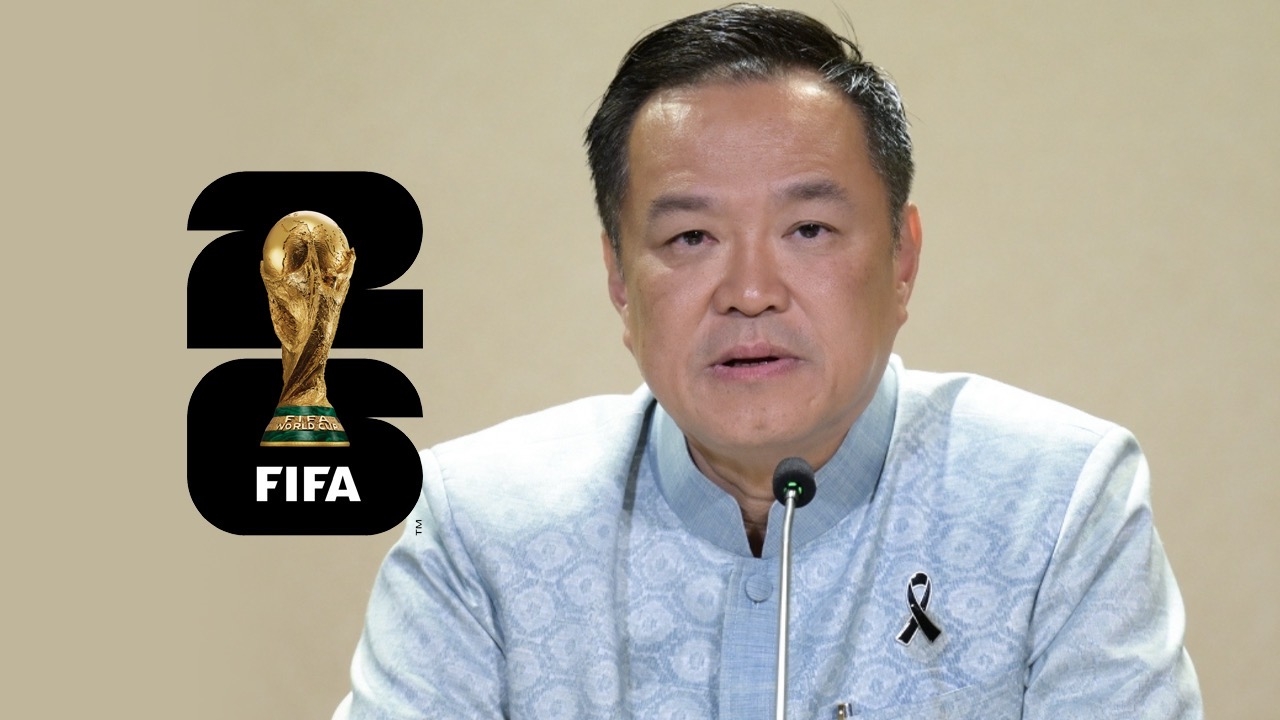
Is 1.5 Billion Baht Worth It!?
Only one month remains!
The 2026 World Cup, hosted jointly by the United States, Canada, and Mexico, will kick off from 11 June to 19 July 2026.
The current question among football fans is simply: "Will Thai people be able to watch the World Cup live as before?"
Because so far, Thailand has not purchased any rights from FIFA, whose prices keep skyrocketing.
Meanwhile, Thai fans have long been accustomed to watching the World Cup "for free" for over three decades.
Recently, Prime Minister Anutin revealed that the government is urgently considering the most appropriate approach.
To ensure Thai people can fully and promptly cheer for the world-class players.
The government is ready to act as a coordinator with all sectors, despite understanding the limitations and current economic challenges faced by the private sector.
This has drawn attention to the model of "pooling resources" between the public and private sectors and how it will take shape.
Regarding this, Big Pok Warong Thiwat, Chairman of the Thai Futsal League, shared interesting opinions on his personal Facebook as follows.
We live in a society where leaders rarely discuss the ecosystem of what must be paid, involving huge sums, sometimes paid with national funds.
Many may be asking, "Should Thailand pay 1.5 billion baht to buy the broadcast rights for the 2026 World Cup?"
Especially since this World Cup is held in the United States, Canada, and Mexico, which have vastly different time zones from Thailand.
This means many matches might take place at 2 a.m., 5 a.m., or very early morning for Thai viewers.
So the question isn't just whether Thai people will get to watch the World Cup.
But whether enough Thai people will watch to justify spending 1.5 billion baht.
At the 2022 World Cup in Qatar, Thailand benefited greatly from the time zone.
Matches were in the evening or late night—not too late—allowing restaurants, bars, beer gardens, marketing campaigns, and brands to easily ride the wave.
The World Cup became a major social event.
But the 2026 World Cup might be different.
Because no matter how much Thai people love football, real life still involves "work" and "time."
Children must attend school, employees must wake early for work, and shops must open in the morning.
Many people may choose to watch highlights rather than live matches. This is the biggest challenge for this World Cup.
1.5 billion baht is not just the cost of rights; it is a "bet" on whether football still has enough power to stop people's time.
To pause people’s daily lives.
However, looking at it another way, the World Cup has never been just a "sports event."
It is a global soft power, a space that unites people, a national content platform, an economic opportunity, and an advertising revenue source.
It is engagement across all platforms.
In an era where the attention economy is the most critical battle,
the World Cup remains one of the few events people worldwide watch live simultaneously.
Even if matches are at 3 a.m., many still stay up, especially for big games.
This value cannot be measured by ratings alone.
But the most important consideration is: if the government or private sector will actually pay 1.5 billion baht,
should they "only buy broadcast rights" or also "purchase economic opportunities" at the same time?
Because if the outcome is only live broadcasts with each party working separately,
then 1.5 billion baht might be just an "expense."
But if redesigned into a "World Cup economic platform," it could have massive potential.
For example, nationwide Fan Zones, 3x3 night football matching World Cup time zones, sports tourism,
24-hour restaurant and cafe campaigns for watching matches,
advertising packages across all platforms, creator economy content,
inspiring youth, connecting the World Cup with Thai football.
Ultimately, the "value" of the World Cup is never just about viewership numbers.
It depends on whether the country can "turn the World Cup into an economy."
If the purchase is only for live broadcast rights, 1.5 billion baht may be expensive.
But if bought to build an ecosystem of economy, sports, marketing, and social happiness,
then the World Cup could be worth many times more than the broadcast rights cost.
In summary, what Big Pok wrote is a call for the government to recognize the value of the 1.5 billion baht to be spent.
Whether it should bring more than just "broadcasting rights for free viewing" that come and go.
If there is no plan, development, or extension to create results in economic or national sports development terms,
then it can be left alone—people in Thailand will find ways to watch the World Cup anyway.
Better to save the money for other more beneficial uses!
- Bee Bangpakong -