

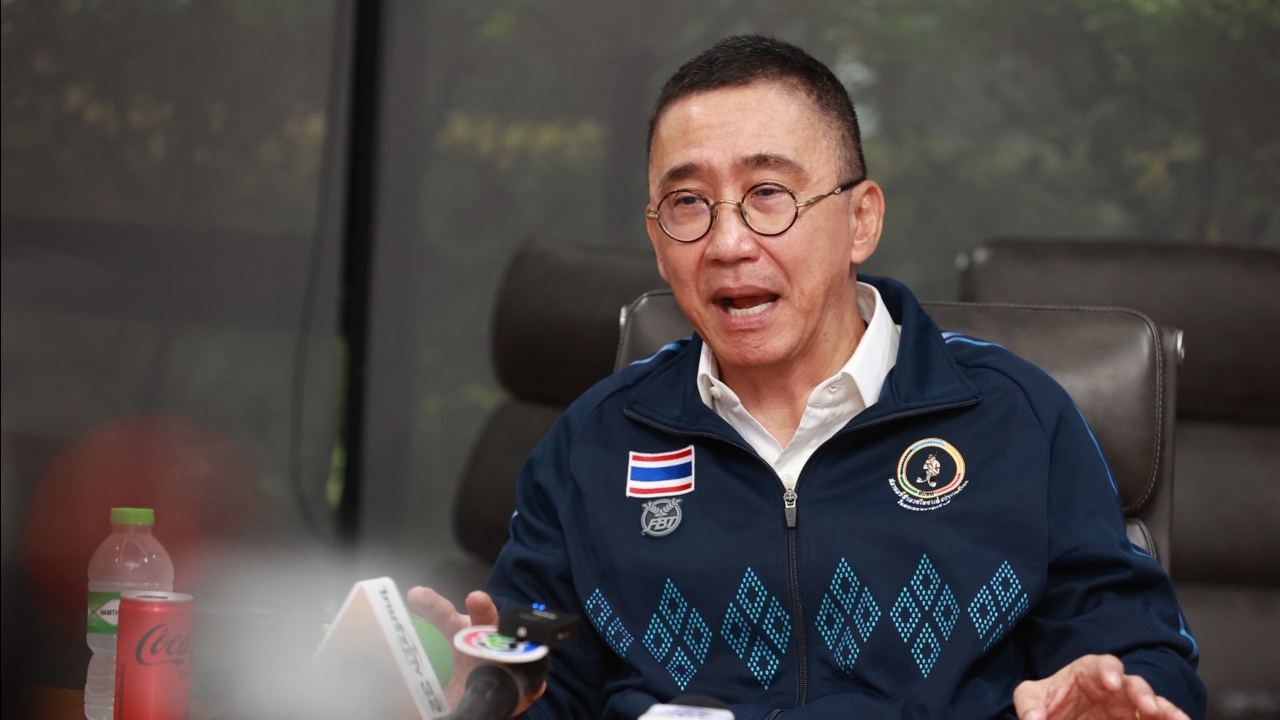
In-depth interview with Maj. Gen. Patchara Rattakool, chairman leading the development of Thai boxing sports, unveiling the roadmap toward the 2032 Olympics.
After the Thai Boxing Sports Association announced its plan for 2026-2028, introducing "Sergeant Dollar" Maj. Gen. Patchara Rattakool as chairman of the Thai boxing sports development committee, the focus is on rebranding to attract younger generations, clarifying identity, and creating a three-year strategic plan emphasizing youth foundations on the path to the Olympic Games, hoping for cooperation without competition or internal conflict.
Maj. Gen. Patchara Rattakool, chairman of the Thai Boxing Sports Development Committee, Thai Boxing Sports Association of Thailand, granted an exclusive, informal interview at Haad Thip Public Company Limited.

Maj. Gen. Patchara Rattakool: I was not originally a Muay Thai boxer nor closely followed the sport. However, as a child, I was a student of Master Khet Sa-ree-yapai, a Muay Thai grandmaster and a friend of my grandfather, so I learned Muay Thai since childhood, specifically Muay Chaiya style. In sports, I boxed in amateur boxing during military academy and continued somewhat while studying in the UK, winning the university featherweight championship. This is my boxing background. I became involved because Dr. Sakchai Thapsuwan, president of the Thai Boxing Sports Association, wanted a team to help advance Muay Thai sports, as the public's understanding of building Muay Thai athletes toward excellence is still limited.
Most Thais associate Muay Thai with professional fighting, not recognizing it as a sport accessible to youth with safety standards comparable to sports like taekwondo, judo, or karate.
My team and I want to raise awareness in Thai society because this heritage is a resource we already have but are not fully utilizing. Looking abroad, millions worldwide practice Muay Thai, yet Thailand lacks enough athletes to select from. For example, at the recent world championship in Kosovo, Thailand sent only three national athletes, clearly showing insufficient athlete numbers.
In reality, we must recruit from professional boxing groups who compete in professional Muay Thai, which differs in rules and details from amateur Muay Thai; the two cannot compete directly. Simply put, professional Muay Thai aims for knockouts, while amateur boxing scores points like amateur international boxing. My team aims to raise awareness and popularity among Thais, encouraging youth participation. I hope the Ministry of Education includes Muay Thai in the sports curriculum because it is our heritage yet underutilized. Beyond excellence, Muay Thai relates to exercise and health.
We can allow children to play safely with protective gear like shin guards, body armor, headgear, and other equipment. Currently, parents might hesitate to invest in Muay Thai training, preferring taekwondo or judo, fearing for their children's safety.
But that's not the case. Besides protective gear, coaches, referees, and trainers are well-trained with safety as the priority.
Muay Thai is included in almost all international sports events worldwide, such as the Youth Olympics, European Games, continental sports in Latin America, the Middle East, Oceania, and other international sports events—except for the Olympic Games and Asian Games. I want Thais to realize that morale is vital for athletes and global recognition. We should be proud that Muay Thai is a global sport present at many international events, though we still lack support in several areas.
Of course, inclusion in the Olympics or Asian Games would be ideal. That is our goal. But today, we must perform our best in every international event we participate in. Muay Thai originated in Thailand and belongs to Thai people, but we want the world to love Muay Thai as much as we do.
Maj. Gen. Patchara Rattakool: I can't do it alone. The first priority is to foster unity in the Muay Thai community. We must support each other because we share a common goal: to increase global appreciation for Muay Thai and encourage more people, especially Thai youth, to practice it. We must not hinder one another. Whoever advances the sport or increases its popularity deserves congratulations. Whether professional or amateur boxers perform well, we should support them. Unity is the foundation and starting point for Muay Thai's progress.
Next, we must quickly build an athlete base and create an ecosystem to continuously produce skilled athletes. Muay Thai's future lies not with today's fighters but with the children we develop, starting from age six upwards, including boys, girls, and LGBTQ individuals, as we are inclusive regardless of gender.
Athlete numbers are the second urgent issue. The ecosystem must include coaching, refereeing, and integrating sports science for injury prevention, doping control, and overall readiness. I want to see many boxing camps across Thailand join the association to promote both professional and amateur paths because Olympic-style international sports require amateur fighters, which we currently lack.
Another aspect is building the ecosystem, which will also benefit the creative economy.
We must make Muay Thai appealing to Gen Z and Gen Alpha. It needs to be trendy and vibrant, not outdated. The stereotype of Muay Thai as violent, linked to gambling and hardship, is unnecessary. Children from wealthy families should feel welcome to learn Muay Thai.
We need a full rebrand, which I believe is achievable. The creative economy offers many opportunities, including cultural elements like Mongkol, Prajead, and boxing shorts. Thailand's talented fashion designers can help us expand and make Muay Thai more attractive to youth.
We must collaborate on short-form content across all platforms. Since I began focusing on this, I was shocked at how far other countries have advanced while Thailand has done little. We should be proud of our heritage, but we are underutilizing it.

Maj. Gen. Patchara Rattakool: Dr. Sakchai Thapsuwan, president of the Thai Boxing Sports Association, entrusted me to preserve the association's achievements that brought us here. Inclusion in global sports events is no small feat, built on decades of work. However, the president tasked me with recruiting younger people to assist because circumstances, awareness, and technology have changed, especially with Olympic standards requiring clear adaptation. We must establish Muay Thai standards recognized globally.
Some say how can Muay Thai have standards when there are many styles like ancient Muay, Muay Chaiya, and Muay Isan? But standards are necessary; without them, we cannot compete. Professional and amateur Muay Thai differ, and amateur must have standards. To engage youth, we need young team members who understand what interests today's youth. We will invite experts from various fields to help make Muay Thai more appealing.
Maj. Gen. Patchara Rattakool: As mentioned, the Olympic Games is our ultimate goal. Given Muay Thai's global popularity, it deserves Olympic inclusion. However, Olympic entry depends on many factors. Look at South Korea's long effort to include taekwondo, requiring cooperation across sectors—not just funding but government and private support and national commitment. Olympic inclusion requires everyone's effort.
It is not impossible. The 2028 Olympics might be too soon with only two years left, but the 2032 Olympics in Australia is more feasible. The host country plays a significant role in selecting sports, as do international relations. Government backing is vital since this concerns all Thai people. We cannot be passive and just thank others; we must act and fund the effort. Everyone wants Muay Thai in the Olympics, but no one has taken action; that won't work.
If everyone does their part, I believe Olympic inclusion is certain—one way or another—because global interest and popularity already exist. It will also clearly show youth that Muay Thai offers both a path to excellence and professional opportunities.
Achieving this, I believe it will become possible.
Maj. Gen. Patchara Rattakool: First, we must be ready. Currently, our ecosystem is insufficient. We must start developing athletes from age six through senior levels to have a strong national team for all competitions, including the Olympics if we qualify.
Second, our ecosystem must be ready in all aspects: venues, boxing camps, coaches, referees. We must train them and integrate sports science to enhance athletes' potential and fitness, including nutrition. Excellence requires a comprehensive approach, not leaving things to chance.
So, the roadmap is to increase athlete numbers, build the supporting ecosystem, and raise awareness to create social momentum domestically and globally that pressures governments and private sectors to support. Media plays a key role in awakening everyone to this national agenda. We cannot just speak of cultural heritage without effort or quarrel over ownership—this belongs to all Thais and requires collective effort.

Maj. Gen. Patchara Rattakool: I believe it is achievable from many angles. The host country can select up to four sports; if they favor us unconditionally, it should be possible without other concerns.
However, how we proceed diplomatically and operationally matters. Since the world already loves Muay Thai, I see it as feasible. The 2028 Olympics might be too soon, but Australia or the 2032 Olympics is a realistic target. Even if not guaranteed, Thais should understand that we are already competing on the global sports stage, though few recognize our national team. If we intensify promotion, it will motivate athletes to join and existing athletes to strive for national pride.
Maj. Gen. Patchara Rattakool: Organizing competitions is crucial because it brings athletes and spectators together.
Next year, we will host international events like the School Sports World Championship with the Department of Physical Education. Before that, we have the World Cup later this year, which is very important and expected to draw thousands of international participants at the school level, including parents and guardians. This boosts the economy. Additionally, we will hold the Youth World Championship for older age groups. These events must be organized.
National team athletes must receive proper care, not be left to chance.
We cannot expect excellence if athletes subsist on minimal support. They need full support in nutrition, doping control, and all aspects of conditioning. When they win, they must receive rewards and incentives to motivate continued effort; otherwise, why compete? Excellence should be recognized tangibly for youth to see.
Maj. Gen. Patchara Rattakool: Currently, I see no obstacles, only opportunities. I have just started, so my view is that everyone must unite and clearly understand roles. There must be no jealousy because we all work for the sport and Muay Thai. Those successful in entertainment-style fighting or professional boxing should be respected. Our focus is amateur sport excellence on the Olympic path, adhering to Olympic principles. Once roles are clear and reconciliation achieved, progress will accelerate. The main obstacle is jealousy, which must be eliminated.

Maj. Gen. Patchara Rattakool: I urge government agencies and the administration to take this seriously. Wherever we go, we will be better received if the government supports us, not leaving us to face challenges alone. The Ministry of Foreign Affairs must be aware and assist us wherever we compete internationally.
This is the candid, open-hearted insight of "Sergeant Dollar" Maj. Gen. Patchara Rattakool, chairman of the Thai Boxing Sports Development Committee, Thai Boxing Sports Association of Thailand, as he prepares to lead a three-year mission starting now.
The show must go on...
