

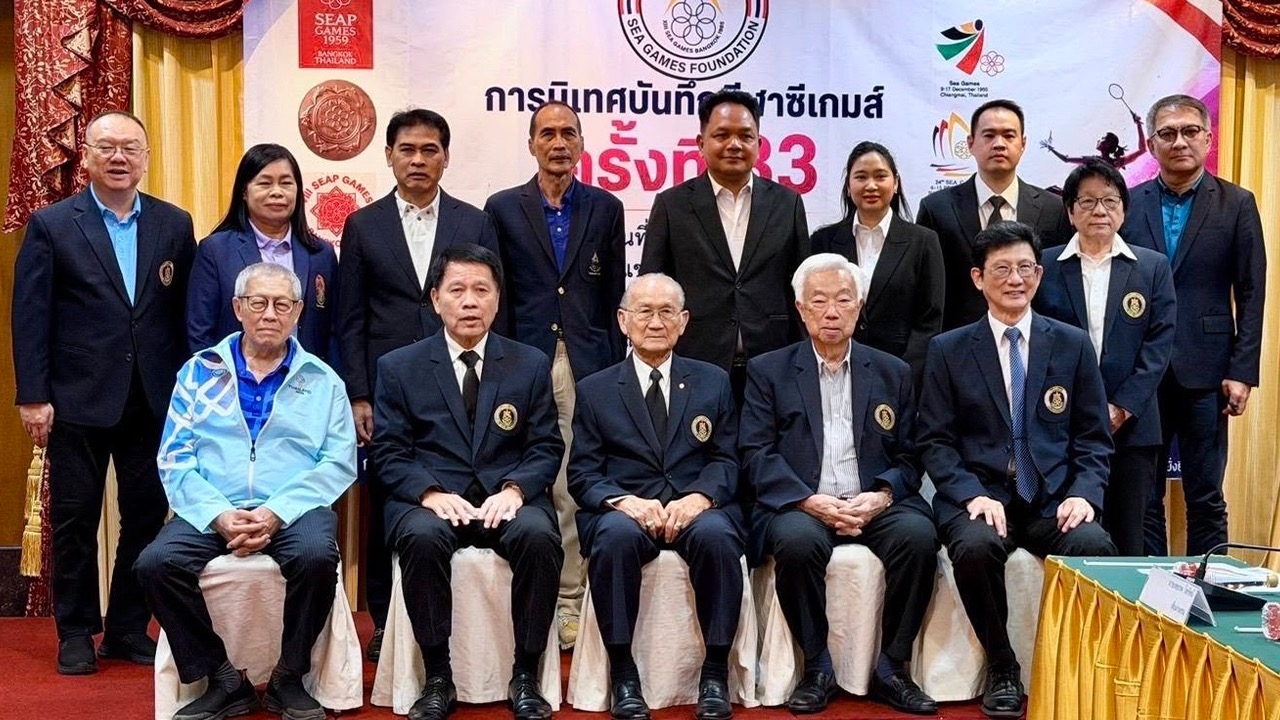
Supervision of the "33rd SEA Games Sports Record" and its documentation.
Last Saturday, I was invited by the 33rd SEA Games Sports Foundation through Phee Wiwat Vikrantnoros, the foundation's secretary, and Phee Sukree Supawareekul, a foundation committee member.
to participate in the supervision of the "33rd SEA Games Sports Record" event held at the Alexander Hotel on Ramkhamhaeng Road.
Dr. Sakchai Thapsuwan, the foundation's vice president, who was appointed by the chairman Gen. Chetta Thanajaro, presided over the opening ceremony.
This event followed up on the "33rd SEA Games Summary" seminar held in February 2026.
It gathered input from all sectors, including the Sports Authority of Thailand, the National Olympic Committee of Thailand, sports associations, and the media.
The academic working group summarized the seminar data to present to the supervision participants for their feedback and suggestions.
The aim was to extract lessons for Thailand's future hosting of sports competitions, summarized as follows.
Mr. Surasak Kerdchantuek, academic working group member for the 33rd SEA Games Sports Record and deputy director of the Sports Authority of Thailand, presented the seminar findings.
Thailand's last time hosting the games was 18 years ago; the event was held across three main provinces, which competed for the most medals in history.
Along the way, political turmoil, border issues, and flooding in Hat Yai affected the event's organization.
The most discussed issue was insufficient budget, with the number of sports exceeding budget estimates.
Combining the SEA Games with the ASEAN Para Games, changing originally planned venues, and preparing to accommodate the full number of athletes were also challenges.
Additionally, the competition's management structure centralized multiple tasks under one unit, while hiring various organizing groups lacking expertise in national-level sports event management.
Meanwhile, Mr. Wiwat Vikrantnoros, the foundation secretary and former deputy governor of the Sports Authority of Thailand, shared insights on hosting international sports events.
He emphasized that key planning for hosting major sports events must include clear objectives, hosting plans, and review of past lessons.
At the government policy level, hosting should be a national agenda sustained across changing governments, enabling all state sectors to collaborate within a broad framework.
This approach would create an organizational structure covering all sectors, producing significant and qualitative outcomes.
Mr. Nattawut Ruangweth, foundation committee member and former deputy governor of the Sports Authority of Thailand, shared his experience preparing athletes for the SEA Games.
Despite challenges from competition and publicity, once athletes performed well, everyone united to support them.
Key preparation elements include athlete training camps, sparring partners, coaches, and sending athletes to competitions to earn rankings.
Most importantly, sports science, sports medicine, and sports technology must be applied to boost athlete morale.
However, past athlete preparation faced long-term problems, with incomplete plans and inflexible regulations.
For example, strict rules on appropriate use of budget created major obstacles.
Thailand's education system does not support athlete development well; requests for athletes to attend training camps often lack continuity.
Mr. Worawut Pongtheerapol, president of the Sports Journalists Association of Thailand, offered an interesting media perspective.
He said readiness for hosting events depends not on money but on structure and management. Natural disruptions are unavoidable, but how we address problems matters.
Today's analysis aims to improve future international event hosting, emphasizing that government policy is crucial and organizers should be professionals knowledgeable about sports.
Mr. Preecha Lalun, deputy governor for excellence at the Sports Authority of Thailand, shared views on management approaches, noting both strengths and weaknesses.
He compared structural issues and the long discontinuity of Thailand hosting major national sports events over several decades.
He concluded that clear national leadership is essential for managing such major sports festivals, a point he fully agreed with.
Those interested in obtaining the "33rd SEA Games Sports Record" book
can request it via www.facebook.com/มูลนิกีฬาซีเกมส์ ครั้งที่ 13 immediately.
- Bee Bangpakong -