

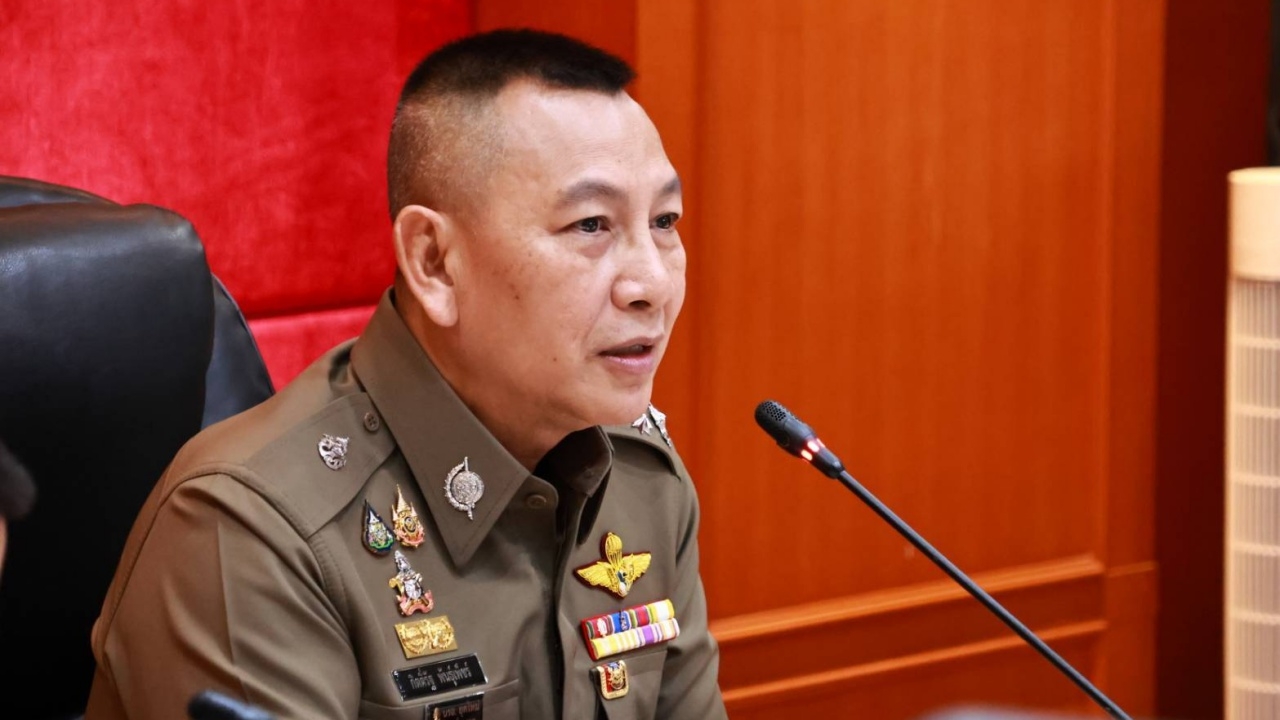
"Big Tai," the Royal Thai Police Chief, emphasized measures to prevent drone-related threats, calling for intensive airspace surveillance around the clock. He requested the public to help by observing, recording evidence, and reporting any leads.
Today (25 Dec 2025 GMT+7), Pol. Lt. Gen. Yingyos Thepjumnong, Deputy Commissioner of the Royal Thai Police and spokesperson for the Royal Thai Police Office, revealed that yesterday Pol. Gen. Kittirat Phanphet, the Royal Thai Police Chief, chaired a meeting on measures to prevent threats from unmanned aerial vehicles (drones). Pol. Gen. Samran Nuamma, Deputy Police Chief, and other relevant officials also attended the meeting held at the Police Operations Command Center.
Regarding the situation around Suvarnabhumi Airport and nearby areas from 20 to 23 Dec 2025 GMT+7, police officers at Suvarnabhumi Police Station in Samut Prakan Province received multiple reports of drones flying near the airport. Special equipment was used to investigate but no evidence confirming drone presence was found. Continuous 24-hour operations remain in place. Currently, areas surrounding Suvarnabhumi and Don Mueang Airports are under intense surveillance.
The Police Chief stressed a three-pillar strategy focusing on prevention (enforcing the No-Fly Zone for drones), investigation, and security. The model "Observe-Screen-Report" is employed, with patrol officers using an object screening application. Suspected drones are reported immediately to the Metropolitan Drone Center to coordinate a rapid response team for interception. Data integration includes drone registration from the National Broadcasting and Telecommunications Commission (NBTC) and flight permissions from the Civil Aviation Authority of Thailand (CAAT) for drone type screening.
The Royal Thai Police spokesperson appealed to the public to assist as the eyes and ears by following three steps if they spot drone-like objects in the sky: observe, record evidence, and report any clues.

1. Confirm whether the object is a drone by distinguishing it from airplanes or stars using the following methods.
Differences between "drones and airplanes"
- Drones fly low or hover stationary and can change direction quickly or sharply; airplanes fly high and move straight along flight paths.
- Drones have rapidly flashing lights in multiple colors (green, red, white); airplanes have standard rhythmic flashing lights.
Additionally, the public can download the "Flightradar24" app, which features a plane-spotting camera showing coordinates and flight information. If no data appears when pointing the camera, it may indicate a drone.
Differences between "drones and stars"
- Drones move relative to buildings or streetlights; stars remain fixed in position, though satellites move slowly in straight lines with steady white light.
- Drone lights are distinct in green, red, and white colors, not just white light.
2. Record evidence: If a suspicious target is found, record a video clip with steady camera handling for at least one continuous minute to clearly show movement patterns, focusing on the lights and flight direction.
3. Report immediately if a suspicious drone is seen in risky areas or near aircraft takeoff and landing paths by calling the hotline 191 or the Metropolitan Drone Center at 02-126-7846.