

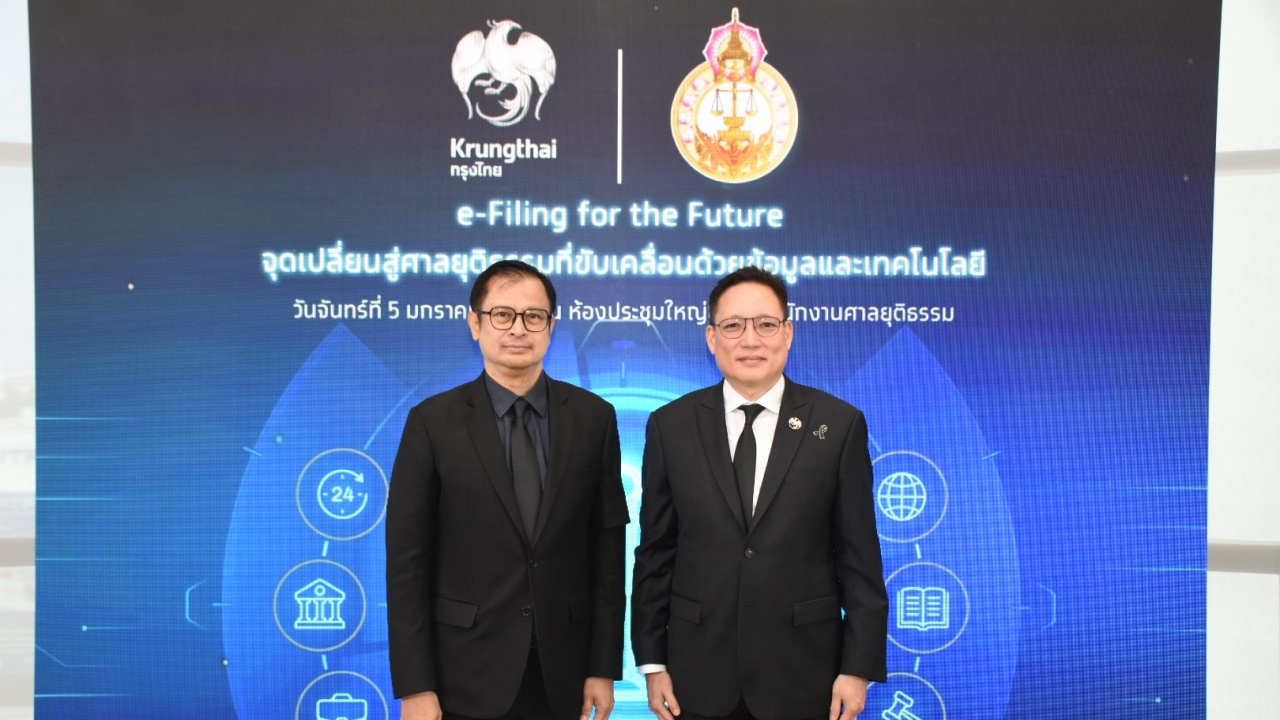
The judiciary upgrades its new e-Filing system aiming to establish a stable, secure electronic litigation infrastructure that covers all types of cases.
On 5 Jan 2026 GMT+7, at the main conference room of the Judiciary Office building, Mr. Teerathai Charoenwong, Secretary-General of the Judiciary Office, together with Mr. Payong Sriwanich, President and CEO of Krungthai Bank Public Company Limited, attended the event "e-Filing for the Future: A Turning Point Towards a Data- and Technology-Driven Judiciary." This event marked a significant milestone in advancing the judiciary's electronic filing system (e-Filing).
Mr. Teerathai Charoenwong, Secretary-General of the Judiciary Office, stated that this round of e-Filing development is under the judiciary’s "Modern Innovation" strategic framework, aiming to build a secure electronic litigation infrastructure that covers all case types. The upgraded e-Filing system is designed to instill confidence in the business sector by providing a trustworthy dispute resolution platform, which will benefit business, finance, investment, and contribute positively to the country's GDP growth and overall economy.
Mr. Teerathai said the judiciary has offered the e-Filing system for several years. This development phase aims to enhance the efficiency, modernity, and responsiveness of case proceedings services to meet the needs of all users. Initially, the service will be available for selected case types during limited hours, with data collection afterward to enable continuous improvement and development.
The Secretary-General of the Judiciary Office explained that the e-Filing version 3 started development in 2017 and has been in use for nearly 10 years amid rapid technological changes. This caused the old system to be unable to fully utilize new technologies. Currently, e-Filing is used in civil cases accounting for over 85 percent of all cases, exceeding the capacity of the original e-Filing v.3 electronic infrastructure. Additionally, security standards, identity verification, and the original system design, which lacked user-centered experience, led the judiciary to see the need for a systematic new system development.

Mr. Teerathai said the idea for this e-Filing development began with the concept that the judiciary’s electronic system must be truly based on user experience. The judiciary launched the e-Filing Idea Hub project to gather feedback and needs from over 700 users of e-Filing v.3, who shared their experiences and pain points. The development team thoroughly analyzed this information, separated issues into software, hardware, and personnel categories, and conducted workshops to test concepts and system prototypes continuously over more than two years before refining the system to its current final development stage.
The Secretary-General noted that this e-Filing upgrade includes several important new functions, such as (1) electronic identity verification (e-KYC) via the ThaID system to enhance security standards, prevent impersonation, and unauthorized account use. All users must download the ThaID application to verify their identity before each login. In the future, the judiciary will consider adding other e-KYC options, such as Paotang Plus or NDID.
(2) Changing the filing method for complaints, petitions, requests, and statements from uploading scanned documents to filling out e-Forms provided by the system. This change will enable data to be used to improve efficiency in later court procedures.
(3) Expanding e-Filing usage to juvenile and family courts for the first time, starting with cases of child recognition with maternal consent, before extending to other case types in the near future.
(4) Implementing notification systems for court orders, hearing dates, and electronic indexes to help users avoid missing deadlines, simplify document searches, and reduce procedural steps.
(5) Adding a system to prevent scheduling conflicts of multiple cases at the same time, which was a problem in the old system, along with other function improvements to continuously enhance efficiency and convenience.
Mr. Teerathai said the upgraded e-Filing service will launch on 5 Jan 2026 GMT+7. Initially, it will be applied to two case types:
(1) Consumer cases where the business operator is the plaintiff, in courts authorized to hear consumer cases; and
(2) Child recognition cases with maternal consent, in juvenile and family courts. If initial use goes well, the judiciary will consider expanding to other case types later. Additionally, service hours have changed. For filing complaints or petitions, users can enter information 24 hours a day, but payment must occur during official hours from 8:30 a.m. to 4:30 p.m. Users filing outside official hours can save drafts and pay later during official hours. Filing other petitions, requests, and statements must occur within official hours.

Mr. Payong Sriwanich, President and CEO of Krungthai Bank, said the bank is proud to partner with the judiciary in developing the e-Filing system, which is a vital digital infrastructure for strengthening the rule of law—a foundation of a transparent, accountable country that builds confidence nationally and internationally. This aligns with the United Nations Sustainable Development Goals (SDGs) aiming for universal access to justice and building effective, transparent, accountable, and inclusive institutions at all levels, alongside enhancing public sector efficiency, which is a key pillar of the Reinvent Thailand initiative.