

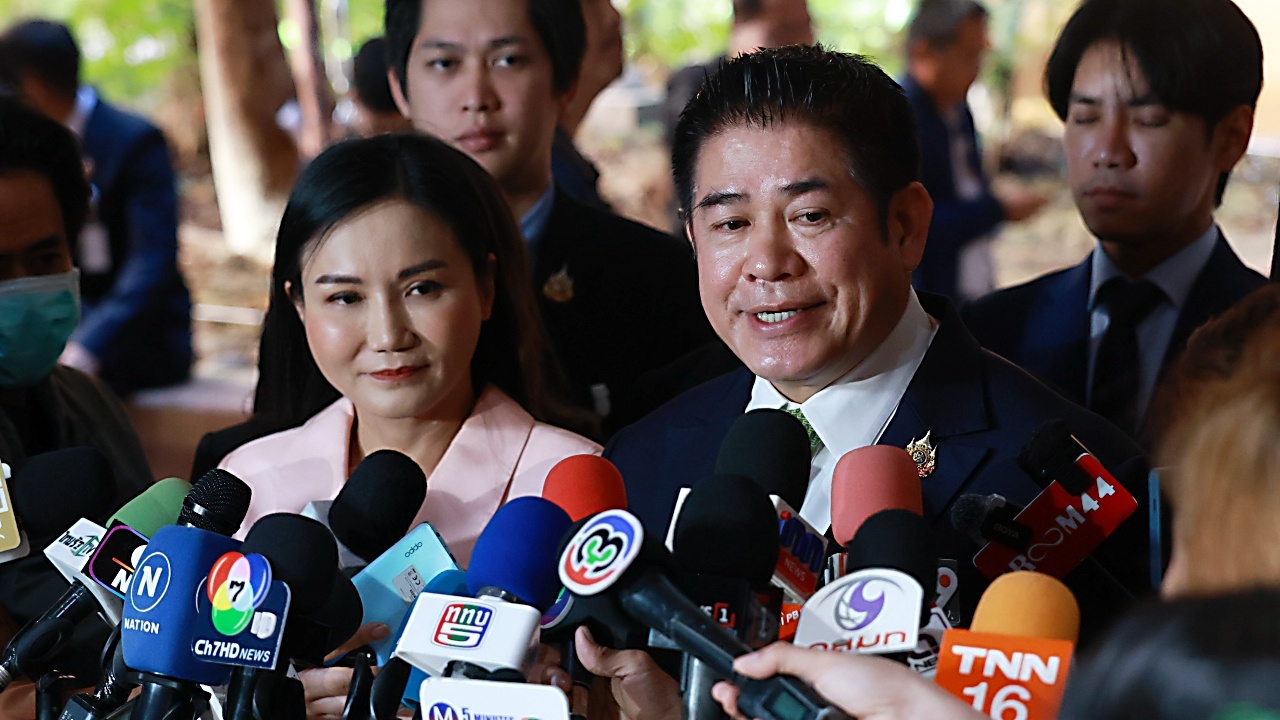
File photo: Lt. Col. Thammanat Prompao and Mrs. Narumon Pinyosinwat.
The Department of Special Investigation (DSI) is preparing to summon Thammanat and Narumon as witnesses after they served as witnesses to the MOU signing on iris scanning of 1.2 million Thais. Following searches at five targeted sites and seizure of iris scanning devices, authorities plan to expand the investigation to track where the data has been transferred.
The case began when Chaiyachon Chidchob, Minister of Digital Economy and Society, revealed the signing of a memorandum of understanding between the Ministry of Digital Economy and Society and Prime Opportunity Fund VCC from Singapore. The signing was witnessed by Prasert Chandraruangthong, then Minister of Digital Economy and Society; Ben Smith; Lt. Col. Thammanat Prompao, then Minister of Agriculture and Cooperatives; and Narumon Pinyosinwat, then Thai Trade Representative. Chaiyachon requested the DSI and the Anti-Money Laundering Office to investigate the facts. DSI accepted the case as Special Case No. 148/2568 to examine the iris scan business exchanging crypto tokens under the Worldcoin project. Prasert Chandraruangthong, Secretary-General of the Pheu Thai Party and former Minister of Digital Economy and Society, and Wallop Rujirakorn, former Secretary to the Minister of Digital Economy and Society, were summoned to testify about the MOU's origin on 23 Dec 2024.
Update on 8 Jan 2025: Reporters learned that after preliminary witness questioning, the special investigation team resolved to collect evidence and request search warrants for five target locations this morning, including four companies and a residence in a village near Rama II Road. The raid uncovered suspicions that a building in Lumpini was used to prepare criminal acts or to store biometric iris scan data, iris scanning devices, data storage equipment, computers, communication devices, general information, and financial data.

The investigation will expand to determine where the iris scan data collected from the iris scanning devices is stored—whether in cloud systems or transferred abroad. The inquiry aims to establish how the iris data of 1.2 million Thais has been used.
The raids at the five target sites today were conducted to collect documentary and physical evidence and to question company officials involved, with the aim of using these findings to decide on legal action if violations are found.
At 14:00 at the DSI, Lt. Col. Surawut Rangsai, Deputy Director-General and DSI spokesperson, disclosed details about the raids in Bangkok on five locations. Some documents were seized from the residence of a company executive in a village near Rama II. At another company near Ramkhamhaeng, four iris scanning devices were found. These devices are crucial to proving where the iris data of 1.2 million Thais has been stored and transferred, which could have future security implications. Currently, the DSI is collecting evidence and witness testimonies before determining the charges and perpetrators. On 7 Jan, he consulted with representatives from the SEC, the authority overseeing the Digital Asset Business Act 2018, which regulates digital token-related businesses, to jointly decide on possible offenders. Though Thailand has not yet defined iris scanning as illegal, comparable laws include the Computer Crime Act 2007 because of the biometric scanning involved. Since digital tokens are involved, the DSI and SEC will jointly consider violations under the Digital Asset Business Act. Clarity is expected within a week, as the SEC views this as a novel case and has already coordinated with cyber police, but information is still under review. The DSI has now taken it as a special case and will proceed with investigations accordingly.

Lt. Col. Surawut said that during the raids and talks with some company directors, they denied collecting iris scan data and claimed they had deleted such data. However, investigators remain skeptical and are collecting evidence to weigh against those claims. One company was originally founded by a Singaporean named George, later transferring shares to Mr. A, who is also a director of another company, linking the operations into a network. Today's searches aim to identify the true masterminds. Mr. A was not found at his residence as he is reportedly out of town but has been scheduled for witness questioning next week. Investigators will ask about his involvement, supported by clear documentary and accounting evidence connecting him to digital asset businesses.
Regarding the origin of the iris scanning devices, documents indicate that one company coordinated with a foreign firm to import them. The company was established after 27 Mar 2024, the date of the MOU signing. However, investigators cannot yet conclude if the devices appeared only after the MOU signing, as further investigation is needed. While it is not yet confirmed whether any company is linked to Ben Smith, today's searches uncovered evidence suggesting some connection.
Asked about reports linking the Singaporean private company that signed the MOU with the Ministry of Digital Economy and Society to Ben Smith and whether the MOU was influenced by him or any Thai officials, Lt. Col. Surawut said such details are too deep at this stage. Generally, the shareholder structure shows the Singaporean company initiated the arrangement. Besides Mr. A, several groups are involved. Regarding images of Lt. Col. Thammanat Prompao, then Minister of Agriculture and Cooperatives, and Narumon Pinyosinwat, then Thai Trade Representative, witnessing the MOU signing on 27 Mar 2024, both will be summoned as witnesses to clarify their involvement.
When asked whether testimony from Prasert Chandraruangthong (former Minister of Digital Economy and Society) and Wisit Wisitsora-at, Chairman of the SEC and former Permanent Secretary of the Digital Economy Ministry, are consistent, Lt. Col. Surawut said there is some overlap but also discrepancies due to the passage of years. Further investigation will continue as the DSI Director-General and the Minister of Justice want a weekly timeline of actions to clarify facts. Iris scanning raises security concerns as it involves sensitive biometric data, and the DSI is coordinating multiple agencies on the case.

Regarding the 1.2 million Thais who had their irises scanned, computers seized from the target locations are being examined for data. The DSI encourages anyone who had their iris scanned to come forward and provide information, as few have done so far. The DSI has begun to understand the iris scanning functions, consistent with ongoing investigations. Any new developments will be reported to the public.