

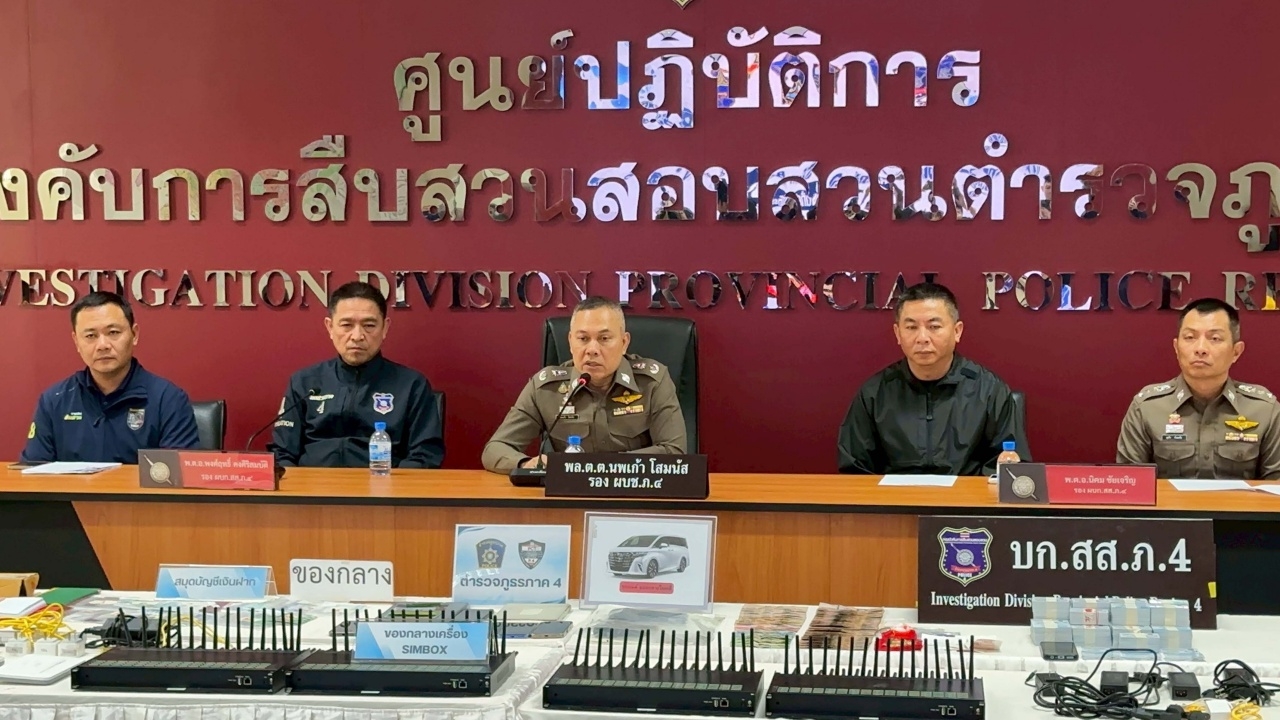
Pol. Maj. Gen. Nopkao Somanat, Deputy Commander of Region 4 Police, announced the arrest of an entire money mule gang, expanding investigations to capture a Thai husband and wife who acted as brokers for the "Poypet" network boss. They managed one bank account earning 6,000 baht and dismantled a scammer network by raiding a simbox operation hidden in a Nong Khai resort, shutting down a call center gang that tricked victims by phone.
At 15:30 on 19 Jan 2026 GMT+7 at the Region 4 Police Investigation Command Center, Pol. Maj. Gen. Nopkao Somanat; Pol. Col. Phongrit Kongsirisombat, Deputy Commander of Region 4 Police Investigation Division; Pol. Col. Somphop Kongsombat, Chief of Investigation 1, Region 4 Police; and Pol. Col. Nuti Saksupap, Chief of Investigation 2, Region 4 Police, jointly announced the arrest of Mr. Kiattisakda Leklom, 56, from Mueang Nong Khai District, wanted under Udonthani Provincial Court warrant 576/2568 dated 24 Dec 2025 for illegal possession of firearms and carrying firearms in public, with two pistols seized. Also arrested was Ms. Ratchanok Watanti, 37, from Sakhrai District, Nong Khai, wanted under warrant 575/2568 from the same court and date.

Previously, Region 4 Police Investigation Division arrested three money mule suspects in Khon Kaen Province. Investigations revealed where their opened bank accounts were sent, identifying recipients in Aranyaprathet District, Sa Kaeo Province. Further probes found related networks sending parcels through 17 courier companies across 7 provinces in Region 4, involving six individuals who received parcels containing bank passbooks, ATM cards, and SIM cards sent to Aranyaprathet, Sa Kaeo. The six were arrested for "colluding in procuring, advertising, or disclosing information to facilitate buying, selling, renting, or lending bank accounts, electronic cards, or electronic accounts for use in technology crimes or other offenses," with 27 bank passbooks, 17 mobile phones, 15 ATM cards, and 15 SIM cards seized.
During interrogation, the six suspects consistently stated that Ms. Ratchanok contacted them to open bank accounts, paying 3,000 baht per account. They either opened accounts themselves or recruited acquaintances to do so, paying the same fee. Most opened accounts required installing bank applications on their phones to allow the employer in Poypet easier fund withdrawals, since ATM card withdrawals were more complicated. After completing each account, they handed them to Ms. Ratchanok to send via postal or private courier to recipients in Aranyaprathet, Sa Kaeo. With this evidence, police obtained an arrest warrant from Udonthani Provincial Court and apprehended Ms. Ratchanok and her husband at their Nong Khai home.
Preliminary questioning revealed Ms. Ratchanok had previously sold her own bank account to a money mule network and was familiar with the procedures and income sources. She coordinated with a Poypet-based money mule network to act as a broker recruiting people to open mule accounts. The overseas boss paid 6,000 baht per mule account, but she paid account openers only 3,000 baht, earning 3% commission on funds transferred into the mule accounts. She thus served as a broker recruiting Thai people to open mule accounts for the foreign boss.
After interrogation, police detained the couple to proceed with legal actions and plan to expand investigations to arrest others involved in the transnational money mule network for prosecution.

Pol. Maj. Gen. Nopkao Somanat also announced the arrest of Ms. Saowanee Thongwiset, 36, from Mueang Nong Khai District, along with seizure of six simbox devices (phone signal converters with SIM slots), five SIM-card wireless Wi-Fi routers, one uninterruptible power supply (UPS), and two CCTV cameras.
Phone service providers in Tha Bo District, Nong Khai, noticed abnormal usage and requested assistance from Region 4 Police Investigation Division. Investigators inspected possible locations of irregular phone signals and simbox devices. Meanwhile, civilians reported suspicious individuals renting short-term rooms at two resorts in Nai Mueang and Meechai Subdistricts, Mueang Nong Khai District, where suspicious persons came and went irregularly, prompting police to investigate.
Police obtained search warrants from Nong Khai Provincial Court to inspect both resorts. In the first, Ms. Saowanee was found inside a room where wiring was cut from the light switch to the ceiling. Inspection revealed simbox devices, SIM-card wireless Wi-Fi routers, and UPS units installed above the ceiling. Similar devices were found in the second resort. All items were seized, and Ms. Saowanee was taken for questioning.

Ms. Saowanee stated she was unaware of simbox devices installed in the room and had only been invited by two male friends to stay at the resort, appreciating the free accommodation. Police detained her and transferred her to Mueang Nong Khai Police Station, charging her with unauthorized use of telecommunications equipment and concealing goods that had not passed customs procedures.
Deputy Commander Nopkao explained that simboxes are devices holding numerous SIM cards enabling calls via mobile networks, converting long-distance calls into cheaper local calls. However, they are primary tools for call center gangs to spoof phone numbers and defraud victims by hiding identities and switching SIM cards to evade detection. The suspect initially denied knowledge, claiming she was just staying at the resort with friends. Investigations continue to determine if the two male friends who left earlier were involved in installing the devices. Police aim to identify and prosecute all involved.
“Residents staying at hotels or resorts within Region 4, if they notice suspicious individuals or customers, can report to any police station 24/7 for inspection. We urge the public to be cautious and not fall for offers to open or lend bank accounts, PromptPay accounts, or wallets, as scammers deceive people into opening accounts supposedly for business or money transfers with easy compensation. In reality, these accounts become money mules used for cybercrime such as scams, online fraud, or money laundering. Even if you are not directly deceiving victims, consenting to open, lend, or provide accounts to others is considered complicity in illegal acts and punishable by law similarly to the perpetrators.”