

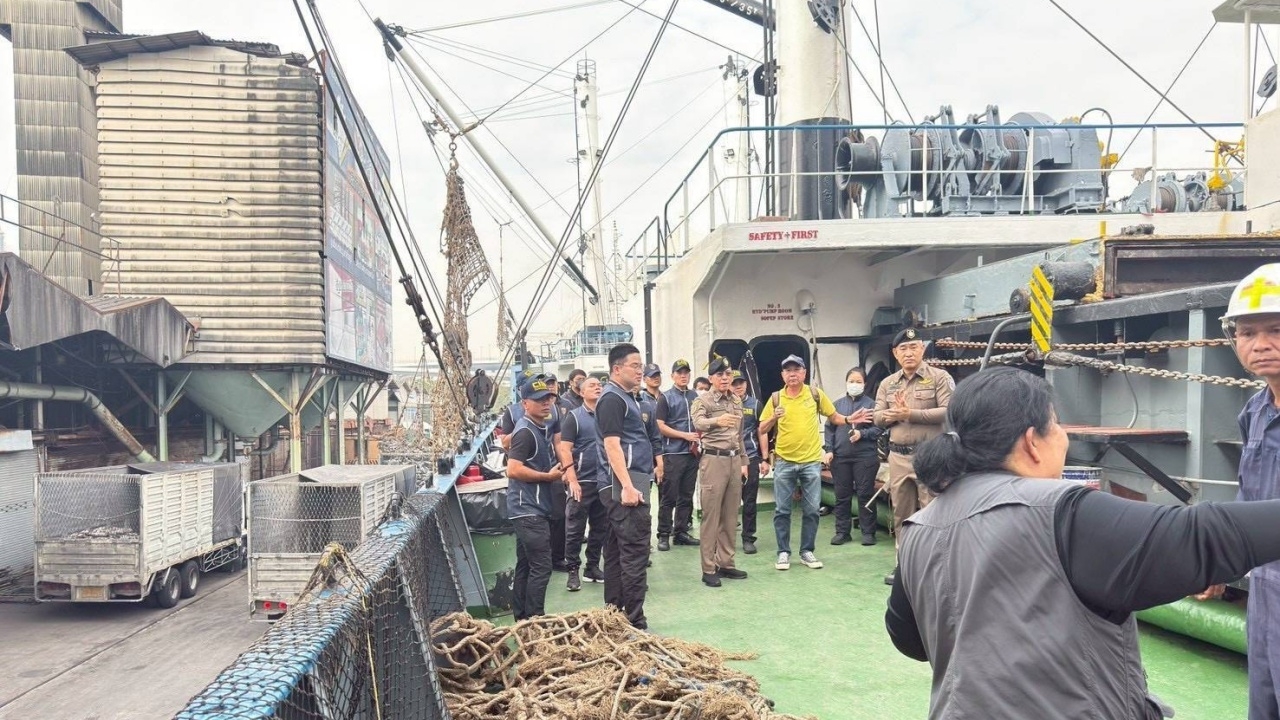
Pol. Gen. Thatchai Pitanilabutr, Deputy National Police Chief, has ordered strict inspections of ships entering Thai waters, stressing that Thailand will not allow its ports or waters to become safe zones for lawbreakers and offenders involved in illegal activities.
Today (27 Jan 2026), Pol. Gen. Thatchai Pitanilabutr, Deputy Commissioner-General of the Royal Thai Police and Director of the Anti-Human Trafficking Center, Royal Thai Police, revealed that Pol. Gen. Kittirat Phanphet, Commissioner-General of the Royal Thai Police, places great importance on enhancing prevention and suppression of human trafficking. This includes law enforcement, prevention, protection and assistance for victims, as well as integrated cooperation with domestic and international partner networks.
The Anti-Human Trafficking Center, Royal Thai Police, has implemented policies and directives to intensify integrated inspections of cargo ships and vessels entering Thai waters. The key goal is to protect the rights of maritime laborers to ensure fair treatment and to prevent forced labor or all forms of human trafficking.

Most recently, on 26 Jan 2026, a joint operation was conducted by key agencies including representatives from the Royal Thai Police, Immigration Bureau, Central Investigation Bureau—comprising the Marine Police Division and the Anti-Human Trafficking Division—the Ministry of Labour, the Marine Department, and civil society partners such as Stella Maris of the Chanthaburi Diocese. This collaboration supports labor protection with a humanitarian approach and close access to workers. They inspected two Panama-flagged vessels: M.V. FONG KUO NO.819 and SEA GLORY II.
Pol. Gen. Thatchai stated that this maritime labor protection inspection is conducted under the Maritime Labour Act B.E. 2558 (2015) and its amendments. This law sets minimum standards for the work and living conditions of maritime workers, aligning with the Maritime Labour Convention, 2006 (MLC, 2006). It covers fundamental rights such as fair and transparent employment conditions, dignified living conditions on board, safety and occupational health, access to medical care, fair wages, and accessible, effective complaint channels. These standards align with the International Labour Organization (ILO) labor protection principles and United Nations (UN) goals, especially affirming that all workers must be protected from exploitation, discrimination, forced labor, and human trafficking regardless of nationality or status.

This firm law enforcement underscores Thailand's role in raising maritime labor standards according to international norms and clearly signals that "Thailand will not allow its ports or waters to be safe havens for lawbreakers." Anyone exploiting labor, using forced labor, or involved in human trafficking will be investigated, prosecuted, and held fully accountable under the law. Thailand is not a place where anyone can break the law with impunity; it stands firmly on human rights, human dignity, and international labor standards to ensure all maritime workers receive safety, fairness, and dignity in their quality of life.
The Anti-Human Trafficking Center, Royal Thai Police, will closely cooperate with relevant agencies to continuously inspect and protect maritime laborers across all areas. This is to ensure maritime workers are protected and that perpetrators of human trafficking and forced labor offenses are prosecuted according to the law.