

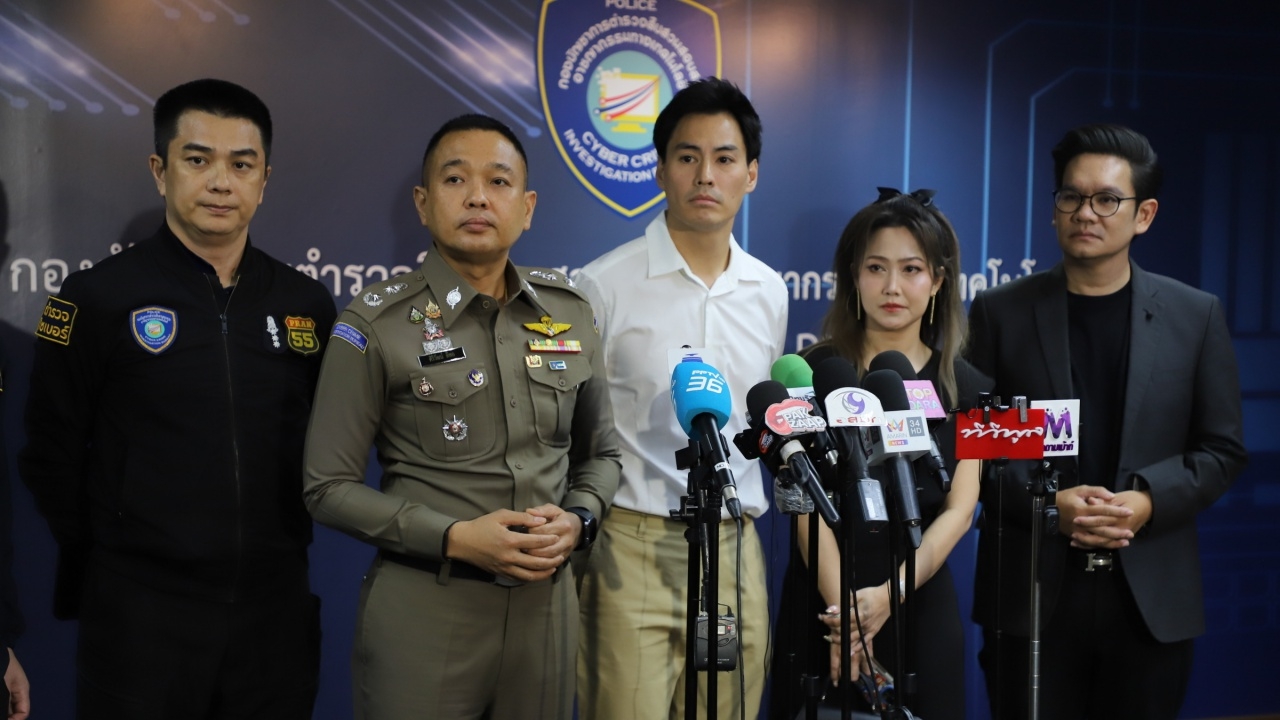
Navin Tar and High Society Namwan filed a report with cyber police after scammers used their names and photos to create fake clips promoting online gambling websites.
At 12:00 on 11 Mar 2026 GMT+7, at the Technology Crime Suppression Division 1 (TCSD 1), Government Complex Chaeng Watthana Building B, Chaeng Watthana Road, Lak Si District, Bangkok, Mr. Navin Yaowapolkul, also known as Navin Tar, a former famous singer and actor, along with his wife Mrs. Pasavee Payakkabut, known as High Society Namwan, and Mr. Kriangkrai Mas Pojanasunthorn, or Kendo, met with Pol. Maj. Gen. Siriwat Deepor, commander of TCSD 1, and Pol. Col. Roj Sak Naiphongsri, chief of division 2, TCSD 1, to file a complaint after their names and photos were used in fake clips promoting online gambling websites.

Mr. Navin revealed he learned about the issue about two days ago after friends sent him clips and links. He discovered that news involving him and his family had been distorted into fake news to attract viewers before enticing them to play online gambling. The fake clips and news were spread across several platforms and received many views.
This caused damage to his and his family's reputation, so he decided to report it to take legal action and warned the public not to be deceived by such scams. He stressed that the circulated news is false and has affected his family's feelings, especially his wife. He urged those responsible to stop these actions and affirmed that he will pursue legal action against all involved.
Mr. Navin added that as a representative of the entertainment industry, many celebrities currently have their names or photos misused similarly. He asked the public to verify information and not trust fake news. He emphasized that anyone experiencing such incidents can report to cyber police to prevent scammers from exploiting others' reputations to deceive the public further.

Meanwhile, Mrs. Pasavee said the fake news severely harmed their family because it involved family members, including her father who is a government official, causing widespread damage to their reputation.
Mr. Kriangkrai Mas Pojanasunthorn, or Kendo, explained that scammers often create clips resembling news reports similar to television news, falsely claiming that celebrities are involved in illegal businesses such as money laundering or gray market activities. Then they lure viewers to click links in the comments, which may lead to gambling websites or links designed to steal users' money or personal information.

. . .Siriwatsaid that this case involves scammers exploiting trending news or famous individuals to create fake news for profit. Preliminary investigations found that links attached to the posts lead to online gambling websites. Police will collect evidence and coordinate with platforms like Facebook and TikTok to track offenders and propose blocking related accounts or content according to the law.
He warned the public not to click links or share posts or clips like these as they risk being tricked into gambling or having their personal and financial information stolen. Victims can report to cyber police immediately.