

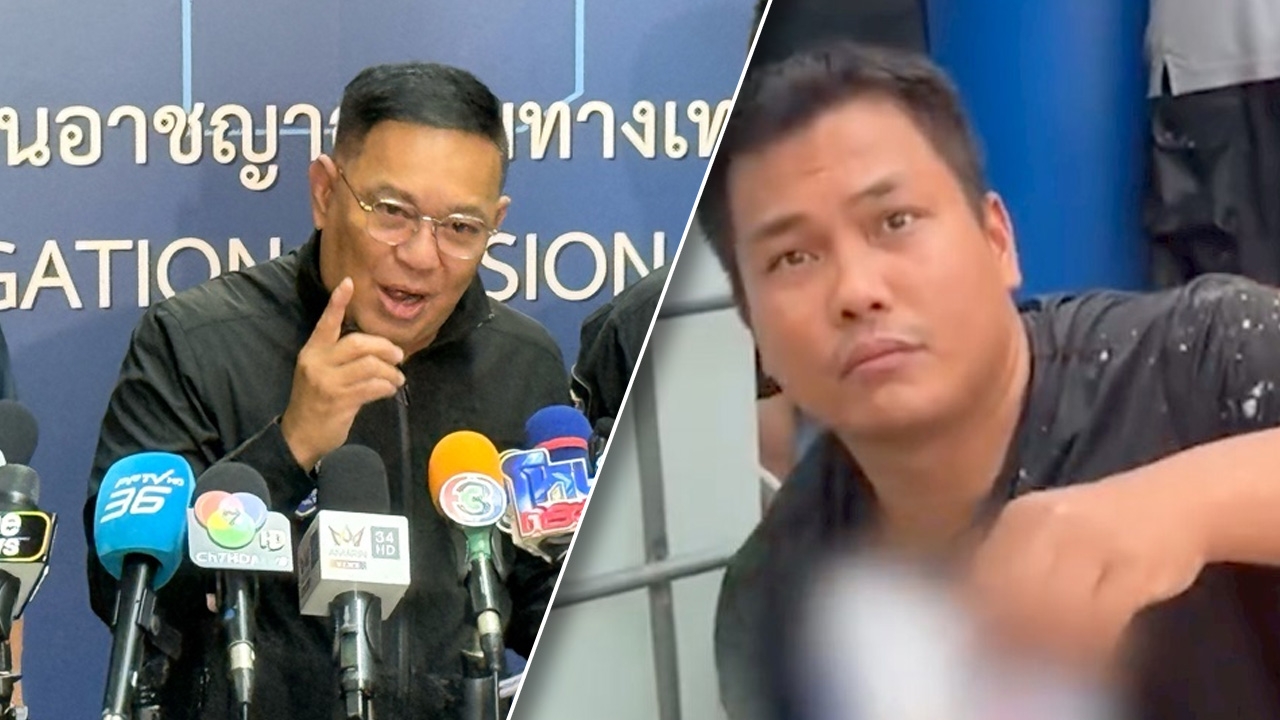
The Deputy Commander of the Cybercrime Division harshly criticized the case of "Bird Wanwangwan," calling it trash after the individual showed no concern. He pointed out that there are multiple legal violations involved and plans to issue a summons for questioning. If serious conduct and clear intent are found, an arrest warrant can be considered immediately.
At 1:00 p.m. on 28 April 2026, at the Technology Crime Investigation Division 1 (TCID 1) headquarters in Chaeng Watthana Government Complex, Laksi District, Bangkok, Pol. Maj. Gen. Chatpanthakan Klayklung, Deputy Commander of the Cybercrime Division, Pol. Col. Thanutrat Kongmun, Deputy Commander of TCID 1, and Pol. Lt. Col. Jirawat Buringam, Deputy Superintendent 4 of TCID 2, jointly held a press briefing on legal proceedings against "Bird Wanwangwan" regarding the use of tile grout during Songkran in Phra Pradaeng, which involved online platforms.

Pol. Maj. Gen. Chatpanthakan revealed that social media content had shown the use of "tile grout" or other substances claimed to be just powder during the recent Songkran festival in Phra Pradaeng, creating misunderstandings and attracting followers. The cyber police have coordinated with Phra Pradaeng Police Station in Samut Prakan Province concerning legal actions related to the online platforms of Bird Wanwangwan. The case will be divided into two parts.

The first part concerns physical criminal cases, specifically the issue of assault. Two victims recently filed complaints with Phra Pradaeng Police Station the previous night. The cases fall under the offense of assault under the Criminal Code Section 295. Investigators have sent both victims for medical examinations; if severe injuries are confirmed, charges under Section 297 for assault causing serious injury will be applied.
Meanwhile, the company owning the tile grout product has issued a statement indicating plans to file legal action against Bird Wanwangwan as well. Initially, the case is expected to involve civil law violations and offenses related to trademarks and consumer protection.

The second part concerns online offenses. Cyber police are currently investigating Bird Wanwangwan’s three social media pages. Content appears to violate Computer Crime Act Section 14(1) by uploading false information into computer systems, including videos showing tile grout being used on people and claims that the powder is starch, not grout, which may be a distortion of facts. It also violates Section 14(2) concerning the dissemination of information causing public alarm, punishable by up to five years imprisonment, a fine of up to 100,000 baht, or both.
Authorities have also coordinated with Phra Pradaeng Police to forward the case to cyber police following procedures, enabling cyber police to submit the URLs of Bird Wanwangwan’s three pages to the Ministry of Digital Economy and Society for closure. This action could be expedited within today or tomorrow. Individuals appearing in the videos who wish to file complaints regarding non-consensual publication may also do so under personal data protection laws (PDPA).
Pol. Maj. Gen. Chatpanthakan added that cyber police operations will proceed alongside investigations by Phra Pradaeng Police Station, which will be the main authority handling the assault case. Summons have already been issued for Bird Wanwangwan, after which charges related to online offenses will be pursued.
Pol. Col. Thanutrat stated that prosecuting those spreading false information online applies when there is intentional fraudulent input of false data into computer systems, such as creating content to attract followers or mislead the public, constituting immediate offenses under the law. Especially when content distorts facts causing public panic, authorities are collecting evidence from statements and published content. If clearly false information is widely shared affecting society, prosecution under Computer Crime Act Section 14 can proceed. Initially, a summons may be issued for questioning, but if the conduct is severe and intentional, an arrest warrant can be issued immediately. Legal penalties include up to five years imprisonment, a fine of up to 100,000 baht, or both.

When asked about online surveillance, Pol. Col. Thanutrat explained that police monitor both physical and digital activities. Upon detecting posts or shares of false, distorted, or potentially illegal content, immediate investigation and further action occur. Regarding content blocking, with sufficient evidence, even without a victim complaint, authorities can request blocking or site takedown. Most processes take under a week through cooperation with platforms, currently supported by AI technologies that continuously detect and remove illegal content.
Pol. Maj. Gen. Chatpanthakan further stated that police are compiling and reviewing other content on Bird Wanwangwan’s pages to determine if additional offenses exist. Based on Bird’s behavior, there is a lack of remorse despite previous detention in earlier cases. He continues to harass the public and produce trash content while out on bail. Police are preparing to petition the court to detain him in the prior pending case.
Regarding how Bird Wanwangwan can remain in society with such behavior, it is known that he traveled abroad to Hong Kong last evening but continues posting videos mocking the police as if untouchable. Authorities confirm these actions constitute evasion and can lead to court-issued arrest warrants if he fails to respond to police summons. Bird is urged to return to Thailand and surrender to investigators, especially if he insists the powder is starch, to demonstrate goodwill and confirm the truth that the powder is starch, not tile grout. He is likely watching and hearing this message. "Hong Kong isn’t fun. It’s better to come back to Thailand. Come back," he said.
Regarding illegal or inappropriate trash content online, this is a national priority for the government. The Ministry of Digital Economy and Society (DE) is currently proposing legislation to enlist platforms’ cooperation in monitoring and controlling harmful and illegal content. The key point is requesting platforms to remove and block content harmful to society, illegal, or harassing the public, especially trash content from well-known influencers, without waiting for police referrals through DE to platform owners as currently done. The growing volume of trash and illegal content, including cybercrime, means delays in official takedown requests risk wider public exposure, more victims, and imitation behavior among children and youth. Although laws cannot force foreign-based private platforms, legislation can encourage cooperation and implement strict measures to block harmful content at the source. The bill is under government consideration, and once enacted, cyber police will be ready to enforce it and help monitor and prevent harmful social media content, as they already do.

Pol. Maj. Gen. Chatpanthakan appealed to the public: if you encounter trash, illegal, or socially harmful content, do not like, share, or comment, as this legitimizes such content as community standards on platforms. Instead, immediately report it to help maintain good online community standards. Tips can be reported via hotline 1441. He also warned influencers producing trash content that harasses the public to stop, as it is both harassment and illegal, encouraging imitative and unconstructive behavior online. Trash content is trash, and no one should give it attention.
The reporter noted that at one point, Pol. Maj. Gen. Chatpanthakan Klayklung, Deputy Commander of the Cybercrime Division, commented on the case: "It really shouldn’t be news. People like this are uninteresting, bad, and can be called trash."