

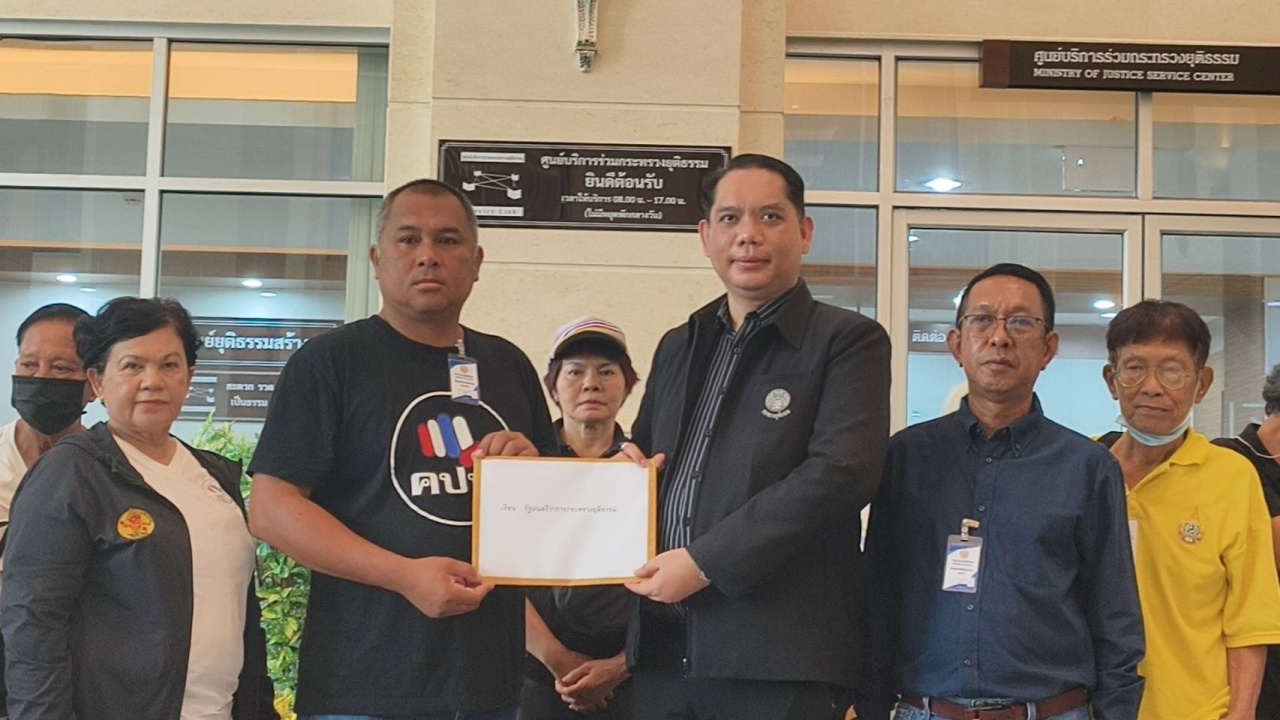
Pichit Chaimongkol, a leader of the People's Democratic Reform Committee (PDRC), stormed the Ministry of Justice to submit a letter demanding suspension of Takshin Shinawatra's parole. He accused the Department of Corrections of misapplying the law and expressed disbelief that if released, Takshin would return home to care for his grandchildren. He warned this could lead to political interference causing Thailand to have two prime ministers.
At 10:00 a.m. on 7 May 2026 at the Ministry of Justice, the People's Democratic Reform Committee (PDRC), led by its leader Pichit Chaimongkol, submitted a letter to the Minister of Justice. The letter requested the suspension of the decisions by three committees considering the suspension of disciplinary or criminal punishments during the detention of former Prime Minister Takshin Shinawatra. Kittiwit Kongbunrak, head of the Ministry's Joint Service Center, received the letter.
Pichit said that previously, PDRC had submitted a letter of objection on 22 January, but recently on 6 May, the Department of Corrections issued a statement regarding Takshin's parole, claiming he had not reoffended within five years, citing criminal code sections 92 and 93. PDRC viewed this as a misapplication of the law, likening it to using civil law to explain a criminal case. They said the department should have examined Takshin's conduct since his imprisonment began on 22 August 2024.
The committees at the Klong Prem Central Prison, departmental, and ministry levels voted to grant Takshin parole with an electronic monitoring bracelet. The Department of Corrections later confirmed the process complied with legal frameworks, was transparent, and verifiable. Especially in statement point 3, which said Takshin had three convictions reduced by royal pardon to one year, and the Supreme Court ruled that time spent at Police General Hospital could not count as detention. Therefore, the one-year sentence did not constitute reoffending under sections 92 or 93, nor was he a habitual offender who reoffended within five years, making him eligible under the Corrections Act and related ministerial regulations as a medium-class habitual prisoner.
However, PDRC considered the department's explanation in statement 3 to be inconsistent with the facts and based on incorrect legal references. They said it lacked thorough consideration of the Supreme Court's order on criminal cases involving political office holders and accused the department of distorting facts. The key points of the Supreme Court's order were: 1. The transfer of the defendant for treatment outside prison violated the Corrections Act Section 55 and related ministerial regulations; 2. The sentence enforcement was unlawful, and the defendant knew he was not critically ill; and 3. The defendant decided against heart and neck surgery but chose less urgent surgeries, causing extended hospitalization at Police General Hospital.

Pichit said the Supreme Court's three clear points show that Takshin knowingly underwent improper sentence enforcement, potentially constituting a criminal offense and a disciplinary violation during detention. Those guilty of disciplinary offenses are disqualified from parole under the Department of Corrections' proclamation Clause 3 (2)(b) and (c), which covers inmates with disciplinary records or who committed offenses while detained elsewhere. Therefore, the three parole committees must consider this issue rather than relying on the absence of reoffending under sections 92 and 93. The department's actions may constitute official misconduct under Section 157.
He believed that since a violation occurred during detention, Takshin should not qualify for parole. He questioned whether the Department of Corrections had initiated disciplinary investigations against involved parties. The three committees from the department, prison, and Ministry of Justice continuing to consider parole could amount to neglect or misconduct under Section 157. Additionally, despite the minister stating that detailed checks were completed, no satisfactory response addressed the key issue of misconduct during detention. Pichit perceived the department's legal explanations as evasive and minimizing the severity of the Supreme Court's order.
Pichit said that if Takshin ultimately receives parole, the PDRC plans to file complaints under Section 157 against the three committees and the Minister of Justice, as they had been formally warned but failed to halt the process.
Regarding the timing of submitting the letter close to Takshin’s possible release, Pichit said he was not worried because the Minister of Justice has the authority to review and reconvene the meetings.
Concerning fears that Takshin would interfere in politics again after release, Pichit said although Takshin claimed he would retire to care for his grandchildren, his actions have been contrary. He believed the Pheu Thai Party, inspired by Takshin, would face interference and increased influence under his control, potentially leading to Thailand having two prime ministers: one in Buriram and one at Ban Chan Song La. This would weaken the party leader's authority to the point of being nominal only, lacking real power. It remains to be seen if Takshin will make the party grow as before or in a way the party leader tries to promote. Therefore, PDRC urges the minister to reconsider and thoroughly suspend the decision.