

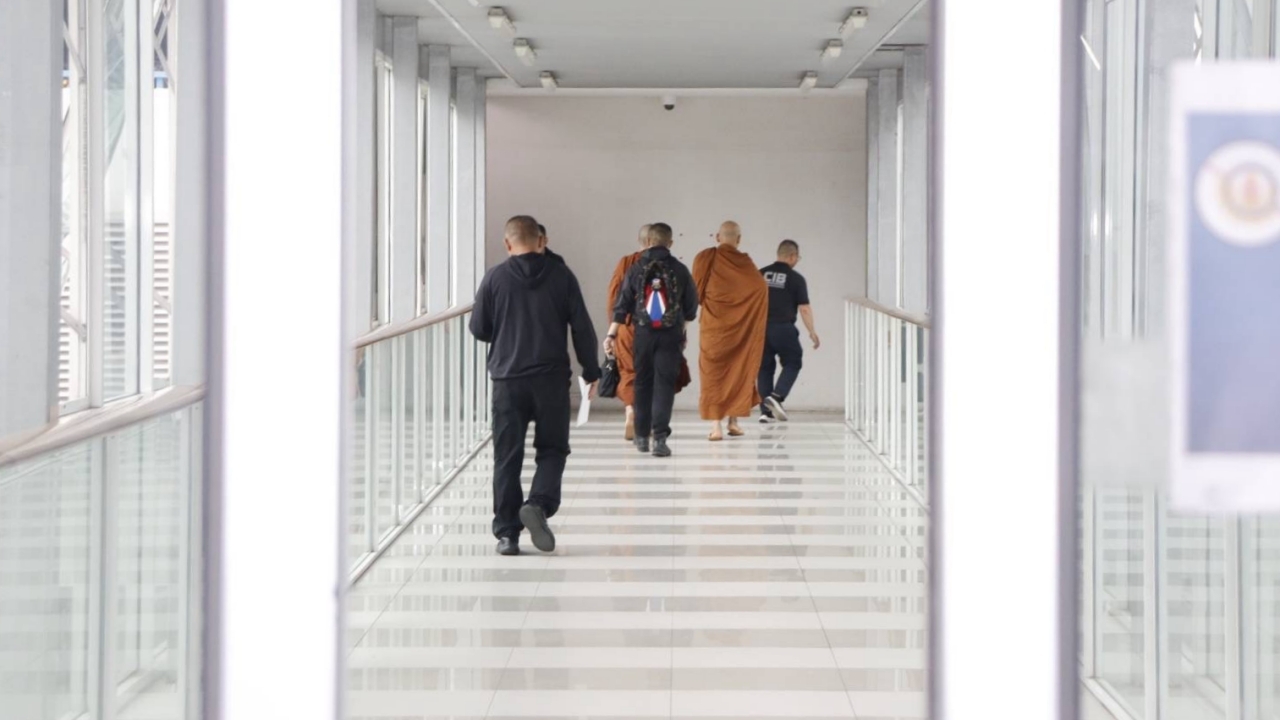
Abbot Kukrit of Wat Napapong quietly acknowledged charges with the Anti-Corruption Police for embezzling temple funds by distributing bonuses to disciples. The temple's lawyer explained that they have filed a rebuttal against violating Section 157, arguing that since the abbot does not govern the monastic community, he is not a state official.
At 08:30 on 12 May at the Central Investigation Police Headquarters (CIPC), Abbot Kukrit Sotthipholo of Wat Napapong, Pathum Thani Province, accompanied by his legal team, met with investigators from Division 2 of the Anti-Corruption Police to acknowledge charges of "embezzlement and misconduct in office." Evidence showed that Abbot Kukrit distributed temple funds as bonuses of several hundred thousand baht per disciple from 2012 to 2016, constituting misuse of temple money. The abbot is currently under questioning.
Abbot Kukrit voluntarily arranged this meeting with investigators to provide explanations regarding the allegations.
At 10:20, after four hours of questioning and fingerprinting as part of the procedure, the legal team requested police to shield the abbot from media waiting outside the interrogation room on the 15th floor of the Anti-Corruption Police Headquarters. They cited concerns about damaging the abbot’s reputation and potential misuse of his images on social media. Police then escorted Abbot Kukrit via a separate elevator to the 3rd floor to exit through a connecting corridor to a parking building, from where he returned to the temple immediately.

At 11:00 at the Anti-Corruption Division, Nantan Inthanon, lawyer for Abbot Kukrit Sotthipholo of Wat Napapong, addressed the media following the abbot's charge acknowledgment. He stated that the abbot received charges under Sections 157 and 147 for embezzling temple funds and has formally acknowledged them. However, they filed a rebuttal against Section 157, emphasizing the key legal issue of whether the abbot qualifies as a public official under criminal law. According to the Sangha Act Section 45, public officials must be monks appointed to monastic administrative roles such as regional or district ecclesiastical leaders. The abbot’s authority is limited to managing internal temple affairs and does not constitute governance over the monastic order, thus he is not a public official under criminal law.
Regarding the opposing counsel’s request to examine the temple's accounts from 2011-2016, the lawyer noted that the Supreme Sangha Council’s regulations were only enacted in 2025 and cannot be applied retroactively. Concerning bonuses paid to four temple employees averaging about 30,000 baht per month, which was reasonable for those working long hours, the lawyer said they are prepared to clarify financial flows if investigators deem such payments inappropriate.
Responding to reports that Abbot Kukrit was stressed during the investigation, the lawyer affirmed that the abbot showed no signs of stress and that the inquiry proceeded smoothly, with investigators showing respect for his monastic status. The abbot declined to give interviews to avoid confronting opponents, but media seeking informal facts may visit Wat Napapong to speak with him. The lawyer stands ready to clarify the legal and academic facts on whether the abbot is indeed a state official.
Regarding a Dhamma scholar with a 9-level certification who appeared on a popular program discussing monastic law, the lawyer expressed willingness to debate on any invited show, especially on the 'Hon Krasae' program.
The abbot’s lawyer also stated plans to take legal action against certain individuals who publicly shared financial records and personal data of over 30 temple disciples, causing them to be perceived as involved in corruption, despite their receipt of funds being lawful.
Additionally, allegations accusing the temple of spending more than 42 million baht on a legal case in Germany and paying 20 million baht in attorney fees were deemed distorted information by the lawyer, who has filed a defamation suit. They emphasized that any complaints or reports based on false or misleading information will face strong legal responses, with some cases scheduled for court hearings in July.