

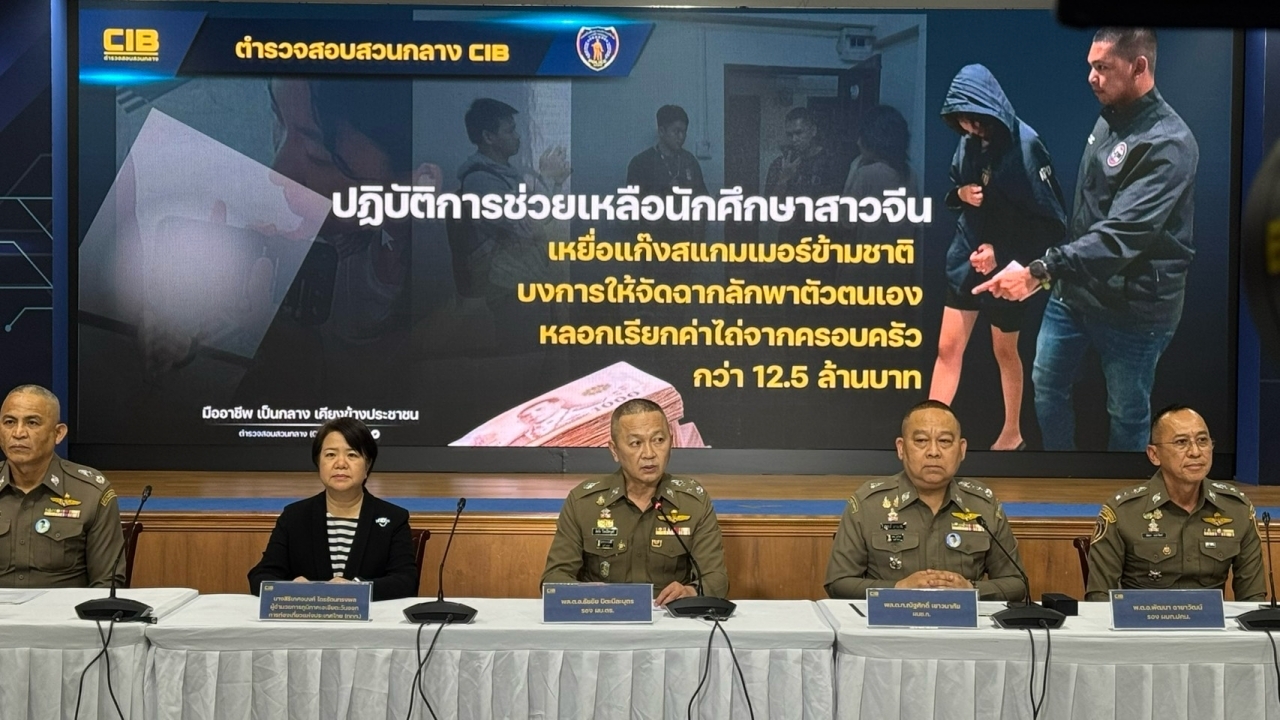
Police General Thatchai announced the safe rescue of a Chinese female student after a cross-border call center gang manipulated her to stage a fake kidnapping and demand a ransom of 12.5 million baht from her family.
On 3 June 2026 at the Central Investigation Bureau, Police General Thatchai Pitanilabutr, Deputy Commissioner of the Royal Thai Police, together with Police Lieutenant General Natsak Chawanasai, Commander of the Central Investigation Bureau, Police Major General Montree Tesakhan, Deputy Commander of the Central Investigation Bureau, and related officials held a press conference on the rescue of a 21-year-old Chinese female student. She had fallen victim to a transnational criminal gang using a "Virtual Kidnapping" scheme after scammers deceived her into staging a kidnapping to extort a ransom exceeding 12.5 million baht from her family.
The incident began when the father of Miss Wang, the Chinese student, received threatening messages via the WeChat app from an unknown man claiming to have his daughter captive. The sender provided photos showing the victim tied up with apparent signs of abuse, demanding a ransom of 3 million Hong Kong dollars (approximately 12.5 million baht). The family reported the case to the Hong Kong Police. Subsequently, the Anti-Human Trafficking and Exploitation Center (ACSC) instructed the Thai police unit KKG 1 of the Anti-Trafficking Division to urgently investigate after receiving coordination from the Hong Kong Police Force.

In-depth investigations revealed that earlier, the criminals deceived the victim into asking her father for money, claiming it was for study abroad proof. The father transferred over 1.4 million Hong Kong dollars (about 5.8 million baht) to the victim's Bank of China account, which was then dispersed to multiple mule accounts controlled by the scam network. On 31 May 2026, the victim traveled alone from Hong Kong and checked into a hotel in the Lat Krabang area of Bangkok on 1 June.
However, police from KKG 1 of the Anti-Trafficking Division examined CCTV footage and evidence, uncovering key inconsistencies. The victim stayed alone in the hotel room with no one else entering or leaving. Further evidence showed she hired a car to buy items such as rope, a knife, body paint, and red lipstick, which she used to stage injuries and record photos and videos. These were sent to the criminals to pressure her family for ransom.

Following leads, authorities found the victim had relocated to a hotel in Bang Phli district, Samut Prakan province, using a forged passport image supplied by the criminals online to check in. Police intervened, controlled the situation, and safely rescued the victim.
This type of crime involves psychological manipulation where criminals impersonate government officials, threatening the victim with fabricated legal troubles. They then instruct the victim to cut off contact with family, hide, and stage a kidnapping to send videos to extort money from relatives. The criminals are not physically present at the scene, constituting a virtual kidnapping.
Police General Thatchai stated that this case reflects the evolution of transnational crime using psychological control over victims. Although no real kidnapping occurs, the damage and the family's distress are very real. In some cases, victims may be deceived into traveling to neighboring countries, risking human trafficking. The Royal Thai Police will closely cooperate with Hong Kong authorities to investigate and prosecute this call center gang.
The Royal Thai Police also urge the public to be cautious if contacted by individuals claiming to be government officials who threaten, demand money transfers, or order cutting off family contact. People should stay calm and verify facts immediately. If anyone has information or needs assistance, they can contact the Anti-Human Trafficking Hotline at 1599, available 24 hours a day.