

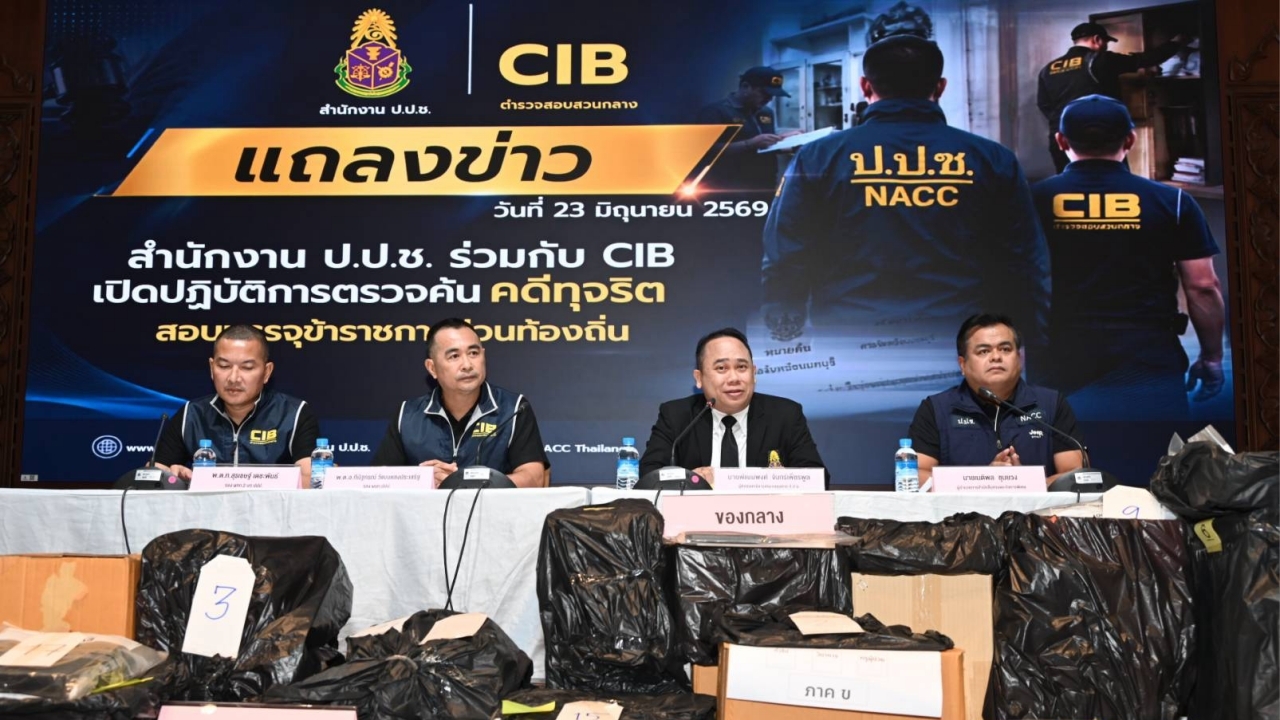
The National Anti-Corruption Commission (NACC) joined forces with the CIB police to dismantle a fraud ring cheating on local government civil service exams. They plan to expand the investigation across the entire corruption chain. Anyone who passed by cheating will not escape. The cost to alter exam answers ranged from 350,000 to 800,000 baht per candidate.
On 23 June 2026 at 10:00 a.m., at the NACC office, Mr. Pattanapong Janpetchphun, Assistant Secretary-General of the NACC, along with Mr. Netipon Chumyong, Director of the Investigation and Special Affairs Bureau, Police Colonel Teenatkon Wattanasaengprasert, Deputy Commander of the Anti-Corruption Police Bureau (ACPB), and Police Lieutenant Colonel Surachet Dechapun, Deputy Superintendent 2 of ACPB, held a press conference regarding the seizure of evidence and arrest of suspects involved in local government civil service exam fraud.
Mr. Pattanapong stated that at 5:45 p.m. on 22 June 2026, Mr. Surapong Intrathaworn, NACC Secretary-General, assigned him and his team to execute a search warrant from Nonthaburi Provincial Court at a company located in Bang Yai District, Nonthaburi Province. The search aimed to locate exam answer sheets used in the offense and related documents, as well as to seize computers and peripherals to access computer systems or data, following complaints about local government exam fraud in 2025.
During the search, over 10 individuals were found at the scene, mostly government officials, editing copies of exam answer sheets in the computer system to assist bribing candidates. This manipulation enabled those candidates to pass the 2025 local government civil service exams by adjusting scores to match those previously announced by the Department of Local Administration on their website, effectively falsifying exam results.
Mr. Pattanapong said the NACC seized numerous documents, copies of answer sheets, and computers, summoning more than 10 individuals for further statements to verify allegations. This operation is the NACC’s first to implement search procedures as a new and significant step, integrating work with inquiry officers, investigation and forensic analysts, and ACPB police officers to secure evidence promptly at the scene. This proactive strategy aims for swift, decisive anti-corruption action.

When asked about the involvement of 'Director Phichit' in the case, Mr. Pattanapong said the NACC has already opened an investigation and is gathering evidence and reviewing data. They must verify whether the answer sheets reflect actual scores. Witnesses described how answer sheets were altered to match exam results. The person asked about is currently under scrutiny, but there is a group acting as intermediaries between answer sheets and exam results. Investigations are ongoing to determine how these documents were obtained and whether any payments were involved.
The documents found are unclear if they belong to the same exam session. Preliminary checks show various dates and times, requiring further investigation to see if other exams are linked. However, officials assure the public not to worry, as seized documents include names and ID codes of all involved, providing key evidence. Details remain unconfirmed and facts may change pending further investigation.
When asked how those who have already been appointed through fraud will be handled, Mr. Pattanapong said evidence collection is ongoing, with case-by-case consideration. Exam processes are managed by respective agencies, but ultimately the NACC can recommend both criminal and disciplinary actions against involved officials. The NACC law allows for removal from office, but such measures require careful consideration due to real personal impacts.
Mr. Netipon Chumyong, Director of the NACC’s Investigation and Special Affairs Bureau, said initial checks had been conducted. Subsequently, a tip-off revealed that every exam answer sheet was being altered. The NACC and police planned a three-day surveillance of the company, observing unusual activity matching the tip-off. They obtained a search warrant and worked with police to find evidence, including computers and answer sheets being edited during the raid. The exam had 87 positions open nationwide with 1,669 vacancies. Reports indicate bribes ranged from 350,000 baht for general positions up to 700,000-800,000 baht in highly competitive provinces.
Police Colonel Teenatkon Wattanasaengprasert, Deputy Commander of the Anti-Corruption Police Bureau, said they were informed by the NACC to join the search operation. Local government exam fraud has long existed, but this is the NACC’s proactive effort to prevent unqualified individuals from entering public service. They searched the site, seized evidence and lists of involved persons, and will investigate origins and methods to identify all offenders. Some who passed after paying bribes of 300,000 to 800,000 baht may lose their posts. This corruption deeply harms the integrity of local government exam systems.
Police Lieutenant Colonel Surachet Dechapun, Deputy Superintendent 2 of ACPB, observed unusual patterns of people entering and leaving the suspect house, starting at 5 p.m. and leaving around 8 p.m. The location is a small alley inaccessible by vehicles. Those coming and going, mainly local government officials carrying suspicious backpacks or bags during evening hours, fit profiles of individuals bringing answer sheets to be altered. This justified the raid.
When asked about the method of altering answer sheets—whether changing names or answers—Police Lieutenant Colonel Surachet explained it was done electronically. They had a correct answer set beforehand and a list of bribe payers. They entered candidate codes into the system; if a candidate initially failed, the system mixed in correct answers to mark which needed correction. The edited answer sheets were then sent to the exam control agency for announcement. When original documents leaked, copies were printed and scores re-entered to send to the agency holding the originals.
Police Lieutenant Colonel Surachet said they understand the downstream process but must trace back to the intermediaries who solicit or receive bribes, as well as upstream actors or agencies involved. Mr. P., a suspect and government official involved, acted as a broker finding candidates seeking appointments and collecting bribes in exchange for passing exams. It remains under investigation where the money went next. Based on evidence and amounts charged, considering 88 positions, estimated damages total approximately 4.5 billion baht.