

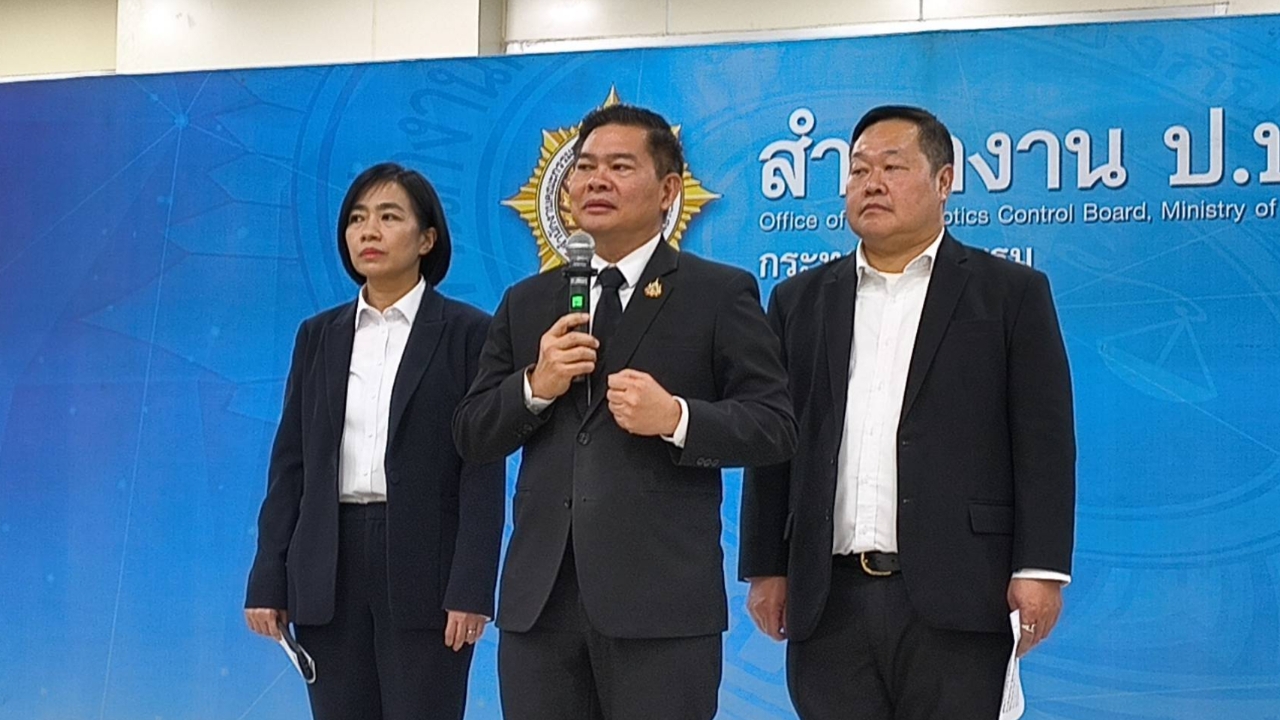
The Office of the Narcotics Control Board (ONCB) expanded its raids on two locations connected to an international heroin trafficking network planning shipments to Australia and Taiwan. The network is linked to the case of a flight attendant arrested in Australia. ONCB has coordinated with the Department of Special Investigation (DSI) to treat this as a special case due to its significance and international connections.
At 13:30 on 2 July 2026, Police Lieutenant Colonel Suriya Singhakamol, Secretary-General of ONCB, together with Deputy Secretary-General Apikit Ch. Rojprasert and Acting Senior Investigator Khwankamon Srichaiwan, held a joint press conference announcing the results of operations to raid and arrest members of a transnational drug trafficking network.
Police Lieutenant Colonel Suriya stated that their goal was to expand the network and identify key perpetrators as much as possible. To protect identities, he declined to disclose the real names of individuals involved during the briefing.
He explained that following the case involving Ms. Meena, who was caught smuggling drugs into Australia, ONCB gathered intelligence on the network responsible for sending drugs to Australia and continued expanding the investigation. The network has a history dating back to 2025. On 30 June 2026, the group sent a package to Bangkok’s Bang Khen and Laksi areas, where ONCB officers seized 8 kilograms of heroin hidden in a cloth bag hanging on a wall. This marked the beginning of the investigation.
Subsequently, ONCB expanded surveillance on the shipment routes and methods. On the evening of 1 July, they conducted raids at two additional locations: Soi Rang Nam and Ramkhamhaeng.
- Soi Rang Nam location At Soi Rang Nam, officers seized nearly 10 kilograms of heroin concealed inside jackets and coffee packages, destined for Australia.
- Ramkhamhaeng location At Ramkhamhaeng, heroin was found hidden inside a pink Thai-style garment. This shipment was not headed to Australia but to Taiwan.

The network’s criminal plan involves receiving drugs from neighboring countries, whose owners are now identified. The ringleaders are from a neighboring country.
This morning, ONCB coordinated with related agencies, including the Internal Security Operations Command and police, to raid and detain those who sent packages from Chiang Khan district, Loei province, down to Bangkok. Authorities are continuing to investigate additional involved parties.
Regarding Australia as a destination, ONCB has identified individuals planning to receive heroin shipments. They have coordinated with the Australian Federal Police (AFP) for their part. Similarly, cooperation with Taiwanese authorities is ongoing for the heroin shipments destined there. The Justice Minister has expressed concern, maintaining continuous contact and providing guidance since the beginning of the case through last night.
This morning, ONCB invited the DSI to a meeting to discuss classifying this as a special case because it involves a large, organized network engaged in deception with inside and outside collaborators, including those handling money transfers, transport, and packaging of heroin. The DSI is experienced in handling such cases and coordinating international cooperation.
Regarding whether Ms. Meena was deceived into carrying items into Australia, ONCB has not yet had the chance to speak with her or her lawyer. They must allow Australian authorities, who follow standard procedures, to determine if she acted without intent but was deceived, which could result in no charges. Meanwhile, evidence is still being gathered, and information is being exchanged. The involvement of additional suspects could have both positive and negative implications, so the extent of Ms. Meena’s involvement remains unclear.
ONCB’s intelligence investigation found that groups involved include flight attendants and ordinary people such as students and tourists traveling abroad, who have been organized into groups selling their luggage weight allowance to smuggle illegal goods. This irresponsible behavior damages Thailand’s reputation. People may be deceived into joining the network. At the two locations raided on 1 July, all individuals denied involvement, but given how frequently such seizures occur, and the business-like nature of selling luggage weight allowance without actual travel, ONCB urges Thai people to be responsible and help combat this problem.
When asked about Ms. Meena’s two trips to Australia—first to Sydney, then Melbourne—and whether she might have been unaware because she was not caught the first time but was on the second, ONCB explained that Ms. Meena travels frequently as a crew member to Australia. The timing coincided with the trafficking network’s delivery schedule to Bangkok.
The network scans for people willing to sell their luggage weight allowance. ONCB’s investigation does not focus on any single person. Those regularly engaged in carrying shipments may be more familiar and have easier contact with the traffickers.
Therefore, it is still not possible to confirm whether Ms. Meena knew or lacked intent regarding her two trips to Australia. Full evidence is not yet available, so ONCB awaits information from Australian authorities.
Ms. Meena was part of the luggage weight allowance system, which involves knowing how much luggage weight one can carry and sharing the leftover allowance. When advertised, criminals in the drug network monitor and tag these offers. Newcomers appear in these groups, while established participants have more trust and continuous transactions.
Among the two locations raided, two people were detained: a female flight attendant at Soi Rang Nam where nearly 10 kilograms of heroin were hidden in coffee packages and jackets destined for Australia, and a middle-aged woman in Bangkok’s Bang Kapi or Ramkhamhaeng area where 6.23 kilograms of heroin were concealed in a pink silk outfit sent to Taiwan. These groups have been operating previously and communicate easily.
ONCB Secretary-General Suriya said there is no need to travel to Australia currently because information exchange is clear. The focus is on dismantling the network in neighboring countries. Arrest warrants will be issued, and plans are underway with DSI to apprehend the ringleader.

Regarding the recipients awaiting heroin shipments from Ms. Meena, ONCB has identified 2-3 Thai individuals at the destination. There are more than just one named “Dear.” The entire network involves multiple Thais working together. ONCB declines to specify if the seized drugs would have been delivered to a hotel in Melbourne, as traffickers have multiple delivery methods such as direct pick-up or leaving packages at storage points.
The transnational trafficking network is connected to suspects previously arrested in Samut Prakan and Chachoengsao provinces. For example, on 27 March 2026, ONCB Region 2 arrested a flight attendant in Chachoengsao before boarding a plane with 20 kilograms of drugs—10 kilograms found in luggage and 10 kilograms at her residence—hidden in rugs. The trafficking routes also involve Nong Khai and Chiang Mai provinces.
Regarding the June 22, 2026 case of a male rider delivering a package concealing heroin to a condominium, the individual remains silent and has not contacted authorities. ONCB continues to expand the investigation and track this person.
When asked whether the 1 July raids are linked to the same heroin trafficking network supplying Ms. Meena, ONCB Secretary-General Suriya said they believe it is the same network, involving flight attendants. The previous flight attendant arrest in Chachoengsao is part of this group. ONCB sees the network as divided into sender and receiver groups. One person was arrested today. The packages come from border areas, packed in finished products such as clothing, instant noodles, tea, coffee, jars, or vases—all imported—and then sent into Thailand. Thais are hired to transport the packages further, acting as intermediaries.
(This part duplicates part 23, so same translation.) Regarding the June 22, 2026 case of a male rider delivering a package concealing heroin to a condominium, the individual remains silent and has not contacted authorities. ONCB continues to expand the investigation and track this person.
(This part duplicates part 24, so same translation.) When asked whether the 1 July raids are linked to the same heroin trafficking network supplying Ms. Meena, ONCB Secretary-General Suriya said they believe it is the same network, involving flight attendants. The previous flight attendant arrest in Chachoengsao is part of this group. ONCB sees the network as divided into sender and receiver groups. One person was arrested today. The packages come from border areas, packed in finished products such as clothing, instant noodles, tea, coffee, jars, or vases—all imported—and then sent into Thailand. Thais are hired to transport the packages further, acting as intermediaries who transfer the drugs into luggage and send them to a third country. The final group is the recipient. The main network owners remain at large. ONCB is making every effort to dismantle the entire operation.
ONCB urges the public who may have suspicious packages in their possession, especially those carrying items abroad to countries like Australia, Taiwan, or New Zealand, to come forward and report to local police stations to declare their innocence. After this warning, if authorities find drugs in packages being carried abroad, individuals will no longer be able to claim ignorance. ONCB asks the media to exercise caution in headlines, as sensational titles like "Thailand as a hub" or "Thailand's decline" harm the country's image. ONCB requests media cooperation to avoid self-inflicted damage.
Police Lieutenant Colonel Suriya said they are tracking the Facebook user “Rose Rose,” who contacted Ms. Meena to arrange carrying Thai goods to Australia. They are also searching for a hooded individual who delivered packages to Ms. Meena. The delivery person is described as over 165 cm tall, nearly 170 cm, wearing a dark hood, and driving a small black sedan similar to a Toyota Eco Car. The license plate was unclear due to the condominium’s location near a commercial area that may allow vehicles to bypass checkpoints. The rider parked some distance away, retrieved the package, then walked to the condo to deliver it. Authorities have not confirmed the rider’s identity but urge cooperation. If the rider is listening, they ask him to come forward.
Regarding whether the male delivery person might have been hired via an app to deliver the package, ONCB says this is possible. Condo records identify him as a Grab driver, but facts remain unconfirmed. ONCB is pursuing all leads and is not waiting solely for his voluntary cooperation.
The Facebook account “Rose Rose” instructed Ms. Meena to send photos once packages arrived. So far, the 8,800 baht paid by “Rose Rose” for the job has not been received by Ms. Meena because the package was seized before delivery. The “Rose Rose” account has changed its profile several times and shows varied activity. ONCB believes it is an avatar account linked to the trafficking network but cannot confirm if it is a single individual.
Secretary-General Suriya concluded that the ringleader of this transnational drug trafficking is a foreigner from Laos residing abroad who hires Thais to carry drugs to third countries. Thailand is not the only transit point for drugs from the Golden Triangle but is used extensively due to its convenient transport routes. The network has operated for over four to five years, with some members already wanted by warrants. The flight attendant previously arrested is believed to be part of the same heroin trafficking network linked to Ms. Meena’s case.
Security camera footage from 22 June at about 12:09 shows a man wearing a dark hood lifting a large brown box from the trunk of a black sedan and walking to Ms. Meena’s condominium. At 12:10, he placed the box on a table at the condo entrance, where a condo staff member received it. The footage shows the man appearing to photograph the package and staying about one minute before leaving at 12:11.