

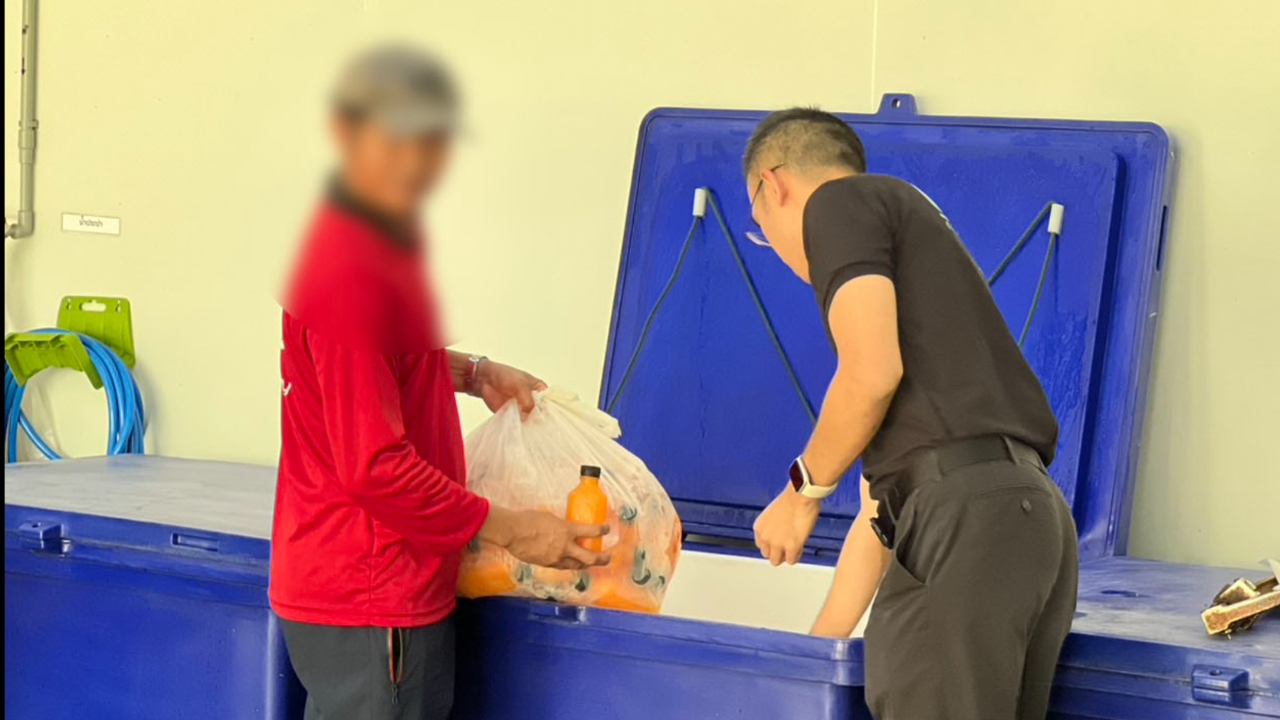
The Central Investigation Bureau raided a substandard ready-to-drink orange juice production site, seizing over 2 tons of Chinese-imported canned orange flakes without FDA approval, valued at more than 500,000 baht.
On 8 July 2026, the Central Investigation Bureau (CIB), through the Economic Crime Suppression Division under the direction of Police Lieutenant General Natsak Chawanasai, Commander of the CIB, ordered Police Major General Thaphum Charuprat, Commander of the Economic Crime Suppression Division; Police Colonel Wiwat Jitsophakul, Deputy Commander; Police Colonel Phattharawut Onchuay, Deputy Commander; Police Colonel Naruephon Karuna, Chief of Division 2; Police Lieutenant Colonel Sathaphon Purahong, Deputy Chief of Division 2; and Police Lieutenant Colonel Chawapon Chueaphet, Deputy Chief of Division 2, to act.
The search team, led by Police Lieutenant Colonel Noppakun Tasnamalai, Superintendent of Division 2, along with officers from Operational Team 4, Division 2, conducted searches at two locations:

1. A company located within Soi On Nut 66, Prawet Subdistrict, Prawet District, Bangkok.
2. An unnumbered warehouse located within Soi On Nut 66, Prawet Subdistrict, Prawet District, Bangkok.
They seized as evidence 112 boxes of canned orange flakes originating from abroad, each box containing 6 cans, totaling 672 cans. Each can weighed 3 kilograms, amounting to a total weight of 2,016 kilograms.
Charges were filed against Ms. Lampoo, 44, for the offense of "concealing, aiding in selling, assisting in disposing, buying, pawning, or receiving goods, knowing them to be related to an offense under Section 242," which is a violation under Section 246 of the Customs Act B.E. 2560 (2017).
This followed information received by officers of Division 2, Economic Crime Suppression Division, that a company in Soi On Nut 66, Prawet Subdistrict, Prawet District, Bangkok,

was allegedly smuggling canned orange flakes imported from China without proper permission or paying correct customs duties. Such products require approval from the Food and Drug Administration (FDA) before importation into the kingdom. Additionally, these orange flakes were used as ingredients in producing bottled ready-to-drink orange juice sold to the public.
Upon receiving this tip, police conducted investigations and found that the company was indeed producing and selling orange juice, and had concealed the canned orange flakes without proper import permits. They collected evidence to apply for search warrants from the Central Tax Court to conduct searches at two sites.
Subsequently, police executed search warrants numbered 264/2569 and 265/2569, dated 25 June 2026, at the two locations to find and seize imported goods suspected of customs tax evasion or being smuggled into Thailand to avoid or evade customs duties, or goods illegal under other laws.

The search uncovered 112 boxes of concealed canned orange flakes, each box containing 6 cans, totaling 672 cans, each weighing about 3 kilograms, with a total weight of 2,016 kilograms. The products were believed to be imported, as foreign language markings appeared on the packaging boxes.
Officers also found various sizes of bottled fruit juice produced using these orange flakes and empty cans from the flakes that had been used in production. When questioned about customs clearance and FDA import permits, the site manager or owner could not present any such documents. Therefore, the police seized the orange flakes and requested the company directors to provide documentation regarding the products.
Later, Ms. Lampoo, a company director, came forward to explain to police that the seized orange flakes were indeed used to produce bottled orange juice for sale. Production was conducted at night and sold during the day according to orders. She admitted she could not provide customs clearance documents or FDA import permits.

Consequently, police charged Ms. Lampoo with "concealing, aiding in selling, assisting in disposing, buying, pawning, or receiving goods, knowing them to be related to an offense under Section 242," a violation under Section 246 of the Customs Act B.E. 2560, punishable by up to five years imprisonment or a fine up to four times the value of the goods including duties, or both. She was summoned for legal proceedings.
In initial questioning, the suspect confessed to all charges.
The Economic Crime Suppression Division continues proactive measures to prevent and suppress offenders smuggling tax-evaded goods, prohibited items, and business operators avoiding customs duties, causing state losses. These acts violate the Customs Act B.E. 2560. The public is advised to be cautious when purchasing consumer goods, especially fruit juices, and to select products meeting standards and approved by relevant authorities.
A warning is issued to business operators involved in importing consumer goods such as food, beverages, or production components to obtain proper permits from relevant agencies before importation. This ensures consumer safety and business credibility. Importing fruit flesh, flakes, or agricultural products may carry pathogens causing disease outbreaks in humans and animals, potentially harming consumers, businesses, and the national economy.