

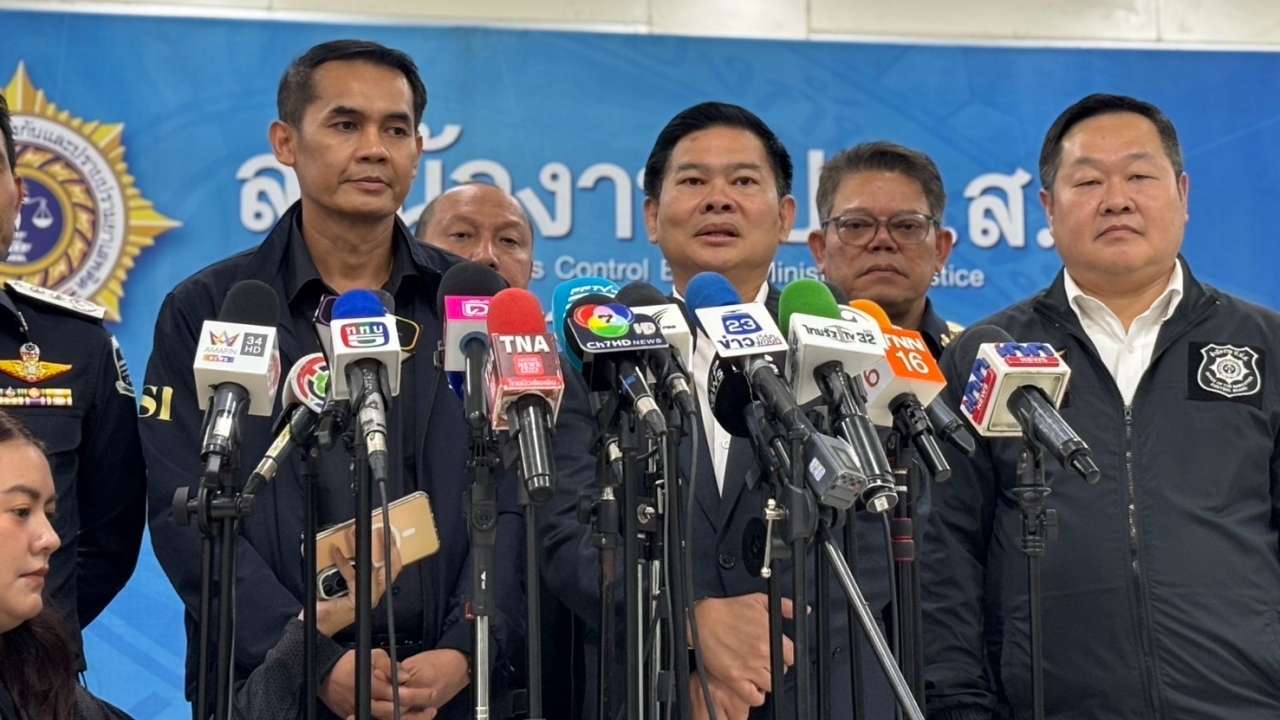
In the latest development of the "Mina the Air Hostess" case, arrest warrants have been issued for three Laotian individuals who delivered parcels concealing heroin into Thailand. Authorities are searching for couriers to transport the drugs to third countries and expect to apprehend them soon. Pol. Lt. Col. Suriya emphasized that efforts focus on uncovering the truth, not on exonerating the air hostess.
At the Office of the Narcotics Control Board (ONCB) on 10 Jul 2024 GMT+7, Pol. Lt. Col. Suriya Singhakamon, Secretary-General of the ONCB, convened a meeting with relevant drug enforcement agencies to discuss various issues regarding transnational drug cases and the case involving the Thai air hostess. The meeting lasted about one hour.
Pol. Lt. Col. Suriya said that following discussions with the Department of Special Investigation (DSI), after the ONCB previously forwarded information about expanding arrests of drug trafficking networks operating in Bangkok areas such as Rangnam Soi, Laksi, and Ramkhamhaeng, the DSI took over the investigation as a special case. Recently, the DSI gathered evidence and obtained arrest warrants from the Ratchadapisek Criminal Court for four men—three Laotians and one Thai—believed to be involved in delivering parcels concealing heroin from Laos into Thailand across the Mekong River in Loei province. The parcels were handed to a Thai-Laotian couple (Mr. Arthit and Mrs. Tadsapon) who arranged shipment via local courier companies to recipients in Bangkok before sending them onward to third countries such as Australia and Taiwan.
Regarding the four arrest warrants, Pol. Lt. Col. Suriya declined to disclose names or detailed information but assured that cooperation with Lao authorities has been ongoing since 2 Jul 2024 GMT+7. Progress is expected soon in tracking and apprehending the suspects for prosecution in Thailand, with little chance of escape. He expressed confidence in Lao authorities' commitment due to their concern about border drug problems. The ONCB and DSI agreed on a joint approach to dismantle the heroin trafficking network or any drug smuggling from Thailand, applying the law strictly against all involved.

Pol. Lt. Col. Suriya explained that the three Laotian men are responsible for bringing parcels concealing heroin from Laos to the Thai side under a fig tree along the Mekong River in Loei province. The parcels were handed over to the Thai couple, Mr. Arthit and Mrs. Tadsapon, who then sent them into inner Bangkok. Whether the three Laotians are the actual drug owners remains under consideration, but current evidence identifies them as couriers from Laos to Thailand. Cooperation with Laos is ongoing to trace the drug trafficking network behind the cross-border smuggling.
He added that preliminary intelligence indicates the mastermind behind the heroin is a Laotian individual, not of mixed heritage, with a prior drug-related conviction in Thailand. Authorities believe they will successfully prosecute the main culprit. They also suspect the network extends beyond the four currently under arrest warrants, likely a large organization. Detailed information is withheld pending Lao authorities' further investigations and arrests. The investigation aims to root out the entire chain from origin through transit to destination, following the Special Case Investigation Act of 2004. Evidence linking the three Laotian men to heroin parcel delivery includes confessions by the Thai-Laotian couple and other clear evidence obtained through investigation and crime route analysis.
Regarding the frequency of drug shipments by the three Laotian suspects, Pol. Lt. Col. Suriya noted multiple instances but could not specify exact numbers because the trafficking process involves several intermediaries once the drugs enter Thailand. Four to five individuals have been identified as receiving consignments at least five times each. It is believed many other network members are involved in transporting drugs into Thailand for export abroad. Some suspects have been issued arrest warrants already, but investigations will continue.
Pol. Lt. Col. Suriya stated that the four suspects currently under arrest warrants are believed to reside in neighboring countries. Due to good relations with Laos, he is confident that Lao authorities have conducted field operations and are seriously pursuing this matter. He requested time for the officers to complete their work, expecting progress soon.

Pol. Lt. Col. Suriya described the trafficking method: heroin concealed in parcels is transported by boat from Laos across the Mekong River to a Thai network waiting under a fig tree along the riverbank in Loei. The Thai network then sends the parcels by post to recipients in Bangkok, who act as intermediaries to forward shipments to third countries. This led to the Ratchadapisek Criminal Court issuing arrest warrants for four individuals—three Laotians and one Thai—as drug couriers from Laos to Thailand. Whether these four are linked to the Facebook account "Rose Rose" is under further investigation, as connections between the international drug trafficking network and the air hostess case are believed to exist, especially involving a middleman possibly named Mr. Uthai (a rider), suggesting the heroin batches may be the same.
The international drug trafficking network operates by two main methods: first, smuggling drugs from Laos into Thailand's Loei province across the Mekong River, involving hand-to-hand delivery to locals in northeastern Thailand, who then pass the drugs to intermediaries for shipment into central Bangkok and onward to couriers responsible for forwarding to third countries; second, direct parcel shipments from Laos to Bangkok awaiting couriers for export. The intermediaries may belong to the same network. Authorities have not limited their investigation to the "Rose Rose" case alone, believing many more individuals are involved and require identification and investigation.
Pol. Lt. Col. Suriya said that regarding developments in Australia as the drug destination, Australian authorities have made significant progress. Thai officials have exchanged information with Australian police, who have actively pursued the case to a resolution. Evidence collected by the DSI and ONCB has been shared with Australian authorities to keep them fully informed.
Currently, in the case of Miss Mina, authorities are exchanging information to gather as much evidence as possible. They deny any suggestion that Thai authorities or society are whitewashing her case. Efforts focus on establishing the facts, including Mina's intent and the involvement of others to varying degrees. Determining the truth is crucial for justice, and all findings are shared with Australian counterparts.
Regarding discretion or evidence that Australian authorities may possess beyond Thailand's, the judicial process in Australia will proceed accordingly. Thai authorities maintain vigilance over other cases and will act decisively, even if individuals claim no intention to knowingly handle drugs. Ultimately, this serves as a lesson to Thai society to stop seeking illegal gains, as involvement in drug trafficking—even unknowingly—is a serious offense with severe legal consequences.
Additional reports indicate that among the four suspects with arrest warrants (three Laotians and one Thai) requested by the DSI from the Ratchadapisek Criminal Court for serious drug offenses, one Thai man named Mr. Klaew has been arrested in Loei province. He is reportedly a close associate and romantic partner of Mrs. Tadsapon, the Laotian wife of Mr. Arthit. Mrs. Tadsapon often accompanied Mr. Klaew when delivering heroin-concealed parcels to the post office. The other three Laotian suspects are currently subject to ongoing arrest efforts by Lao authorities.