

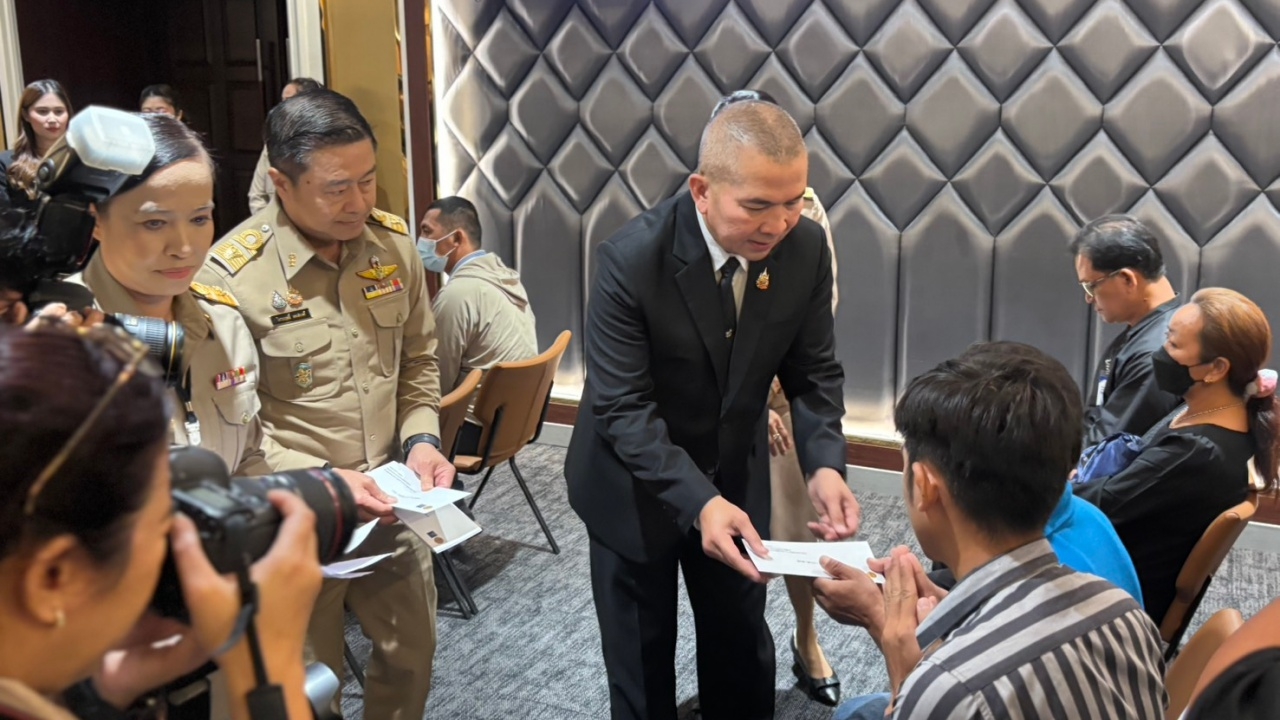
The Minister of Justice and the Department of Rights Protection have provided compensation of 300,000 baht each to 14 heirs of victims in the Lat Phrao Beer Factory fire case, totaling 4.2 million baht initially. They noted it as a heinous, shocking case that impacts the country's image.
At 09:00 on 20 July 2026 at the Ministry of Justice, Police Lieutenant General Ruthaphon Naowarat, Minister of Justice, presided over the ceremony to present compensation funds to heirs of victims from the Lat Phrao Beer Factory fire. This was in accordance with the 2001 Act on Compensation and Expenses for Victims and Defendants in Criminal Cases (amended in 2016). Fourteen heirs received 300,000 baht each, totaling 4.2 million baht. Mr. Trairith Temhiwong, Director-General of the Department of Rights Protection and Liberties, reported on the event, which was witnessed by ministry executives, officials, and the media.
The ceremony involved awarding compensation to 14 heirs present, each receiving 300,000 baht totaling 4.2 million baht. For the remaining victims not present, payments will be directly transferred to their bank accounts. A total of 31 victims have been considered, amounting to over 9.3 million baht, including heirs of Nong Breeze (female lead singer of the Tosakan band), the band's Laotian drummer employed at the venue, and members of the public. The event aimed to publicize and provide assistance under the 2001 Act and its 2016 amendment. The case is heinous and shocking, attracting public attention with numerous deaths, damaging the nation's image. The state must provide humanitarian compensation to both Thai and foreign victims who suffered death, bodily injury, or psychological harm from crimes committed by others, without implicating them in wrongdoing, as an initial relief measure.
Over more than 24 years since the enforcement of the 2001 Act and its 2016 amendment, the state has provided assistance to victims in the justice system (both victims and innocent defendants). This includes 145,613 criminal case victims receiving 7,618,957,376.31 baht and 2,815 criminal defendants receiving 641,303,138.25 baht, totaling 148,428 individuals and over 8.26 billion baht. This funding comes solely from the state budget, while demand for assistance is rising. Therefore, efforts are underway to improve the efficiency and effectiveness of victim assistance in the justice process.
On the same day, in Meeting Room Basi on the 3rd floor of the Best Western Plus Wanda Grand Hotel in Pak Kret District, Nonthaburi Province, the Department of Rights Protection and Liberties, together with Mahidol University, held a workshop to gather opinions on establishing a criminal case victims’ fund. The aim is to create a revolving fund, like those abroad, that can raise money from other sources such as donations, recovery from offenders, and court-imposed fines. The workshop also studied measures and guidelines to prevent individuals from becoming victims within the justice system (victims, suspects, and innocent defendants).
Mr. Trairith Temhiwong, Director-General of the Department of Rights Protection and Liberties, stated that this disbursement is pursuant to the 2001 Act and its 2016 amendment. Victims who died and were not involved in wrongdoing receive 300,000 baht each. Compensation has been paid to 31 victims so far. Recently, the death toll rose to 34, but the subcommittee expedited consideration for these 31 victims first. Regarding whether business owners will receive compensation, if investigations find they committed offenses, they are not considered victims and thus not eligible.
Regarding criticism about using taxpayers’ money for compensation in criminal cases deemed unreasonable, he expressed gratitude for all opinions, which will inform future adjustments to criteria. Currently, the subcommittee follows the 2001 Act and its 2016 amendment criteria: if a person is not at fault and has been affected, compensation is assistance for suffering. Many cases revealed during field visits involved families lacking even funeral funds, having to borrow money for funerals. He views compensation as a human rights assistance measure.
Mr. Trairith added that today's consultation with Mahidol University on establishing a victims’ fund is vital. Currently, hundreds of millions of baht annually aid victims in criminal cases who are not offenders, such as victims of the crane collapse in Nakhon Ratchasima (where all victims were passengers), the collapsed State Audit Office building, and a mass shooting at a child development center in Nong Bua Lamphu. The recent fire incident is similar. Offenders should compensate damages, but waiting for court proceedings can be lengthy. Hence, a victims’ fund is proposed, with ongoing forums to discuss funding sources beyond the regular budget.
They plan to source funds appropriately, including recovering money from offenders or classifying criminal cases to facilitate legislation of the Victims’ Assistance Fund Act. The aim is for full approval by the Council of State and Cabinet. This aligns with government goals to compensate victims without burdening the budget. However, regarding human rights, the government cannot remain passive. This intent aims to support criminal case victims as before. The proposed Act will be separate and not overlap with the 2001 Act and its amendment, with its own criteria for compensation. The current forum is open to all opinions before defining scope. Meanwhile, they must comply with existing laws to alleviate criminal case harms, although no one wants such incidents to happen.
Mr. Trairith addressed the case of Teacher Sai’s husband (Ms. Benyaphorn Panpetch), aged 30, who died from coronary artery disease after San Camillo Hospital denied an electrocardiogram (EKG) and misdiagnosed panic disorder. Recently, the hospital ordered the dismissal of the 70-year-old part-time doctor involved. The Department has dispatched Ratchaburi justice officials to gather information and requests for compensation to compile facts. If police investigators charge the responsible party with negligence, it will strengthen the victim’s claim.
However, the Department does not await the hospital's internal disciplinary investigation results for the doctor, as compensation follows the 2001 Act, while disciplinary matters are separate and handled by the employer. Initially, the deceased’s family is expected to receive 300,000 baht from the subcommittee. He expressed deep condolences to the family, emphasizing that although the incident was unwanted, mechanisms exist to provide assistance and compensation.
Mr. Theerayut Kaewsing, Deputy Director-General and spokesperson of the Department, disclosed that in the Uncle Piak case, on 22 July, prosecutors from the Anti-Corruption Division 2 in Rayong summoned seven suspects, all police officers from Aranyaprathet Police Station, to file charges at the Rayong Criminal Court for Corruption and Misconduct. This case has drawn significant public attention since the law’s enactment. Evidence suggests possible violations under the Enforced Disappearance Act. The court’s decision remains pending. The Department continues to monitor and observe to improve law enforcement systems.
He clarified that enforced disappearance law covers not only cases of permanent loss of contact but also situations where individuals disappear briefly without legal protection, with no contact with relatives or unknown fate. Such cases qualify as enforced disappearances under this law.
The Deputy Director-General further noted that the Anti-Corruption Court has previously sentenced military trainers for offenses against conscripts. The Uncle Piak case is the first involving law enforcement suspects and civilian victims concerning enforced disappearance and torture charges. The court’s acceptance of the case and subsequent judgment remain to be seen.
The Department has fully compensated and continues to support Uncle Piak. Since the Enforced Disappearance Act’s implementation, disappearance reports have decreased. Before the law, lack of awareness among officials partly contributed to cases. Although some abuses of power still occur, they have become less frequent.
