

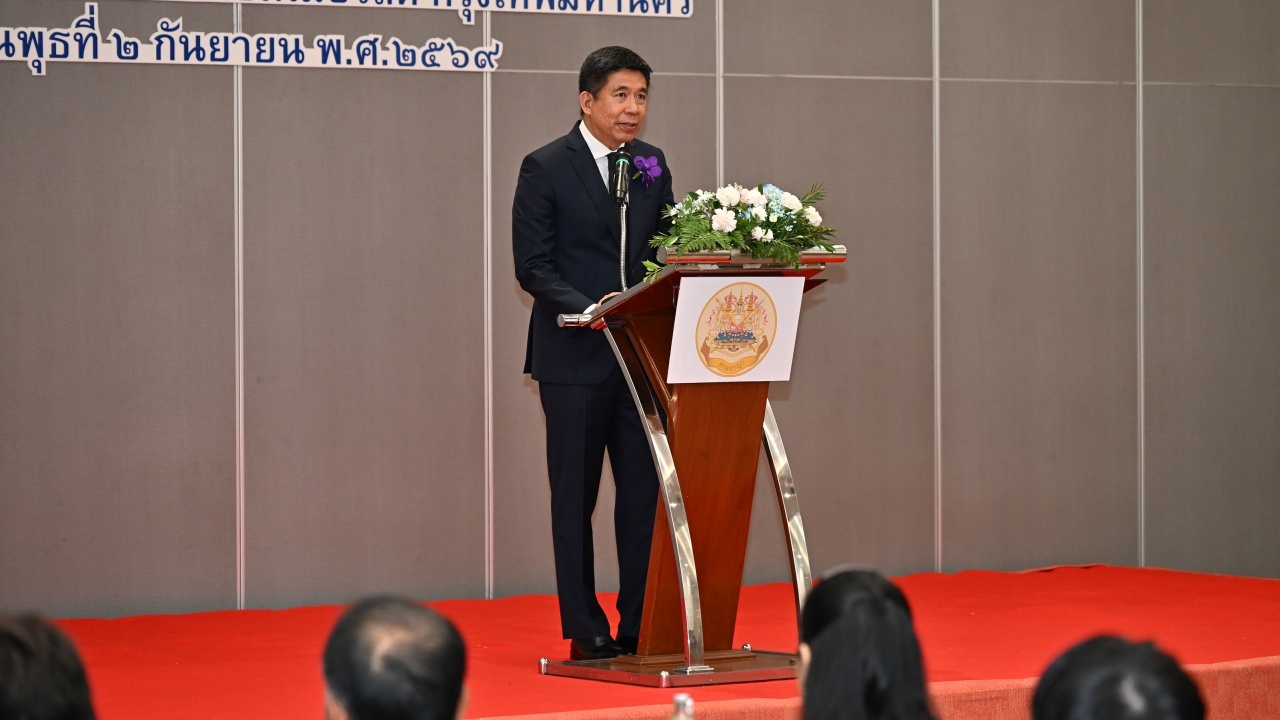
The Criminal Court has united with partner networks to launch the 2026 Justice Process Coordination Project, aiming to enhance public protection by rapidly blocking illegal websites and proactively countering online threats.
At 09:30 on 2 Sep 2026 GMT+7, at The Emerald Hotel, Mr. Jirapath Pantawi, Chief Justice of the Criminal Court, presided over the opening of the “Justice Process Coordination Promotion Project for Fiscal Year 2026.” Attendees included Mr. Patchara Anantsilp, Permanent Secretary of the Ministry of Digital Economy and Society; Mr. Thepsu Bowornchotidara, Secretary-General of the Anti-Money Laundering Office; Police Lieutenant General Jiraphop Puridet, Assistant Commissioner of the Royal Thai Police; Mr. Chawrong Limpapatmapani, Chairman of the National Press Council; and Dr. Piti Tandakesem, Director of the Bankers’ Association, who joined the event to exchange views.

Mr. Jirapath stated that technology today plays a role in nearly every aspect of daily life. However, malicious actors exploit it as a tool for increasingly diverse and complex crimes. Technology crimes can occur rapidly, transcending borders and causing widespread harm. They continuously evolve in form, technique, and deception methods, making isolated justice processes ineffective. Preventing, suppressing, and prosecuting technology crimes require close cooperation and coordination among courts, prosecutors, police, law enforcement, technology agencies, financial institutions, and relevant organizations to effectively and promptly protect the public from online threats.

The Chief Justice said the seminar “Justice Process and Public Protection from Online Threats” provides a valuable opportunity for all agencies to exchange knowledge, experiences, challenges, and obstacles encountered in practice. The goal is to find ways to make inter-agency coordination faster, more agile, and efficient, thereby enhancing each organization’s operations and building a strong, sustainable collaboration network.

Mr. Rattawit Ariyaphatphon, Supreme Court Assistant Judge temporarily serving as Chief Judge of the Criminal Technology Crime Division at the Criminal Court, said technology crimes have become increasingly complex. Offenders use technology to defraud and easily access victims. The speed of online systems and financial transfers has greatly increased damages. A major concern is that some victims are unaware they have been targeted or are unintentionally involved—for example, through mule accounts lent to others. If such accounts are used in criminal networks, owners may face multiple serious charges. Statistics show technology crime cases have risen steadily since the Criminal Court established the technology crime division in April 2024, nearing the volume of drug cases and continuing to rise. This highlights the urgent need for the justice system to adapt quickly to protect the public effectively.
"The Criminal Court has a crucial mission to protect the public from online threats. Beyond normal case adjudication, the Court rigorously blocks or suspends illegal websites. In 2024, this activity was extensive, continuing through 2026 until August, when over 700,000 URLs had been blocked—averaging about 100,000 per month," he said.

Furthermore, protective measures for victims of online sexual harassment have been implemented, allowing victims to file petitions directly with the Court to suspend or remove inappropriate images and content without needing to file a police report or hire a lawyer, ensuring timely assistance for victims," said Mr. Rattawit.