

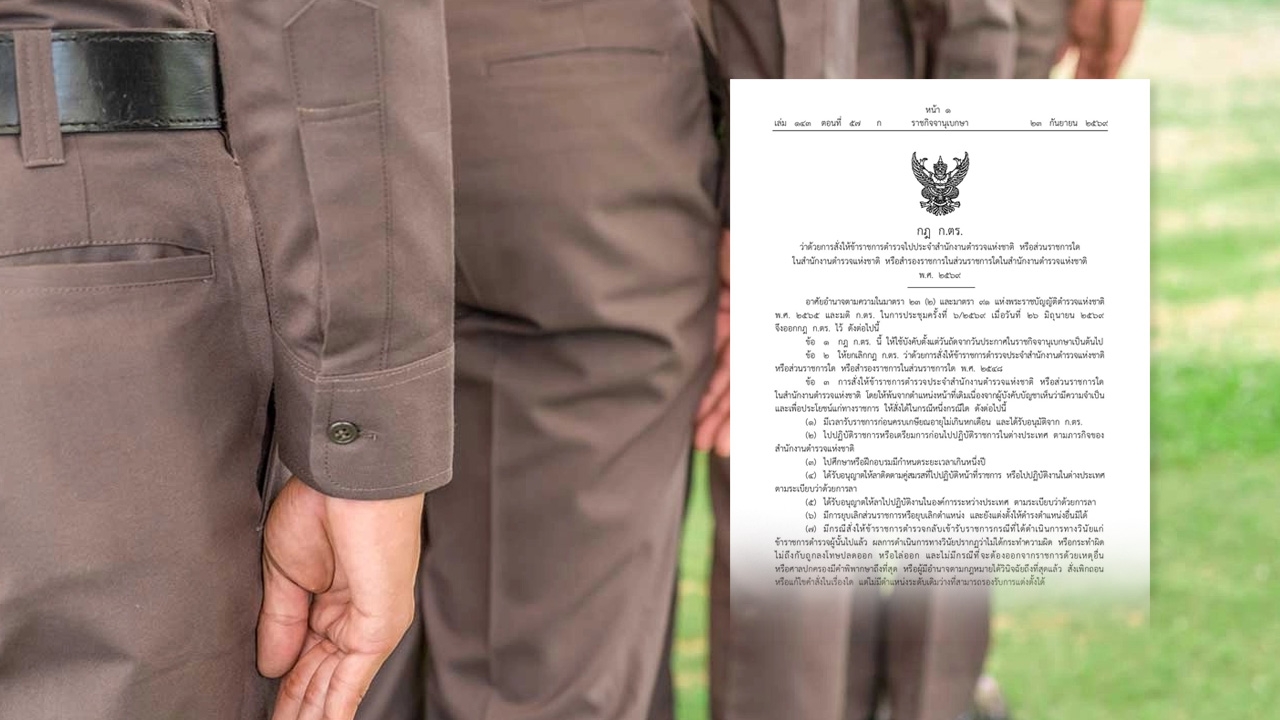
The new Police Commission Regulation B.E. 2569 (2026) has come into force. It clearly defines criteria for ordering police officers to "permanent" or "reserve service" status, distinguishing administrative cases from those involving disciplinary or criminal issues. It also protects benefits during such assignments and sets clear procedures for high-ranking officers. The regulation was published in the Government Gazette on 23 Sep 2026 GMT+7.
On 24 Sep 2026 GMT+7 at the Royal Thai Police Headquarters, reporters noted that the Government Gazette website published the Police Commission Regulation concerning ordering police officers to serve at the Royal Thai Police or its divisions, or to be placed in reserve service within its divisions, B.E. 2569 (2026). It was signed by Prime Minister Anutin Charnvirakul as chairman of the Police Commission. This regulation officially took effect today (24 Sep 2026 GMT+7) to ensure personnel management within the Royal Thai Police is orderly, efficient, and aligned with the National Police Act B.E. 2565 (2022).
The key content of this Police Commission Regulation sets clear conditions for temporarily removing police officers from their original duties, divided into two main types: "permanent assignment" and "reserve service." Permanent assignments apply mainly for administrative and personal mission reasons, such as officers with less than six months before retirement, traveling abroad for official duties or study exceeding one year, authorized leave to accompany a spouse working overseas, or when their unit or position is dissolved. It also covers cases where officers have been proven innocent in disciplinary or criminal proceedings and are ordered to return to service but no equivalent position is currently available.
Meanwhile, reserve service orders focus on managing officers with disciplinary or behavioral issues. Supervisors may issue such orders when an officer is under serious disciplinary investigation, is a criminal suspect (excluding minor or negligent offenses), or exhibits inappropriate behavior or lack of discipline affecting law enforcement effectiveness. Notably, if an officer exhibits misconduct, their original position is reserved for only three months. If the reserve service period exceeds this timeframe without resolution, the position may be permanently filled by another person.
However, this regulation continues to protect the rights and benefits of officers ordered to permanent or reserve status by treating them as if they still hold their original rank in all respects, including salary increments and disciplinary status. Once the necessity ends, they will be considered for reappointment to their previous or equivalent positions at the earliest vacancy. Additionally, procedures for ordering permanent or reserve status for senior officers at commander level or above require submission for royal acknowledgment, while for the national police chief, deputy chiefs, and inspector general positions, a royal decree is required to remove them from office.
Reference: https://ratchakitcha.soc.go.th/documents/132041.pdf