

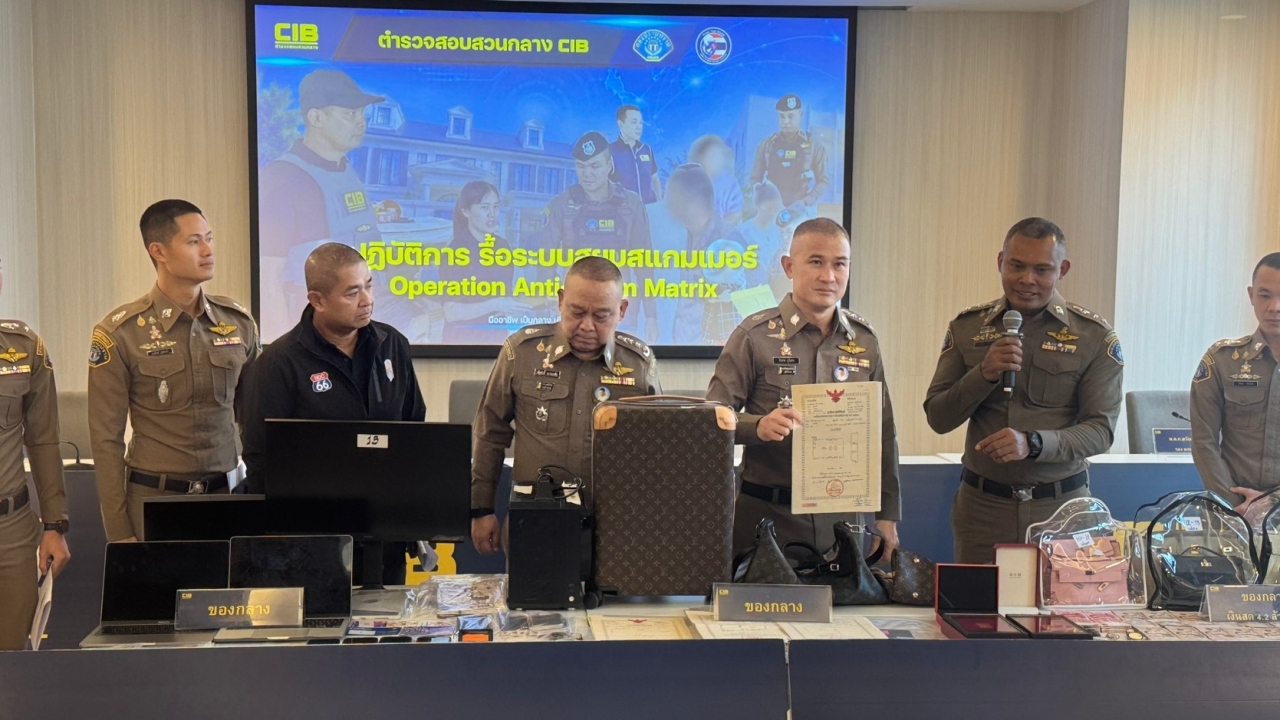
Assistant Commissioner Kong announced that the ACSC Center, in collaboration with the Central Investigation Bureau, launched the "Anti-Scam Matrix" operation, conducting raids at 27 locations across Thailand to dismantle a transnational scammer and money laundering network, seizing assets worth over 500 million baht.
At 10:00 a.m. on 13 Oct 2023 GMT+7, on the 10th floor of Pitak Santi Building, Central Investigation Bureau Headquarters, Pol. Lt. Gen. Jiraphop Puridej, Assistant Commissioner of the Royal Thai Police and Deputy Director of the Anti-Online Crime Center (ACSC), along with Pol. Lt. Gen. Nattasak Chaowanasai, Commander of the Central Investigation Bureau, Pol. Maj. Gen. Puttipong Musikul, Deputy Commander, Pol. Col. Pongpanot Chukaew, Deputy Commander of the Crime Suppression Division, Pol. Col. Thanawat Hinyokhin, Commander of Division 5, Crime Suppression Division, Pol. Lt. Sorun Sripak, Deputy Commander of Division 5, and Pol. Lt. Chanakan Burapaka, Inspector of Division 5, jointly held a press briefing on the "Anti-Scam Matrix" operation. They dismantled a transnational scammer network by searching 27 target locations across 11 provinces nationwide, seizing assets valued over 500 million baht.
Pol. Lt. Gen. Jiraphop revealed that over the past year under the ACSC Center's oversight, daily financial losses have dropped from about 100 million baht to just over 30 million baht in the past one to two months. Although the figures have improved somewhat, new cases continue to arise. Entering the second year or season two of operations, cooperation with foreign agencies has been enhanced. Currently, foreign partners have increased trust and confidence in Thailand’s transparent work and data sharing.
The key lead for this operation came from the ACSC Center, which reviewed the list of foreign nationals holding Thailand Privilege visas and cross-checked it with online complaint data. They found irregularities involving bank accounts belonging to Chinese nationals holding such visas, receiving transfers from criminals who defrauded the public. Consequently, they assigned the Crime Suppression Division to investigate and expand the case.
Authorities gathered evidence and obtained arrest warrants from the Criminal Court for involved individuals, then launched raids at 27 targets across 11 provinces: Bangkok, Chiang Mai, Chiang Rai, Samut Prakan, Saraburi, Singburi, Nakhon Pathom, Chonburi, Kalasin, Narathiwat, and Ranong. They arrested 39 suspects per warrants, including 30 Thai nationals, 8 Chinese nationals, and 1 Myanmar national, charged with conspiracy to defraud the public, impersonation, inputting false computer data, and money laundering.
They also seized numerous items and assets such as 8 luxury properties worth over 330 million baht; land titles and condominium units in the Rama 9 area valued over 90 million baht; a luxury residence in Bangkokkret valued over 60 million baht; 10 luxury cars; cash and foreign currencies totaling over 4.2 million baht; digital assets including USDT; as well as valuable items like jewelry, luxury watches, and branded handbags. The total seized assets exceeded 500 million baht.

Pol. Lt. Chanakan explained that victims were deceived by criminals through Facebook into investing in Block Trade stock trading, promising high returns. Victims were then added to Line groups managed by call centers that manipulated the market and encouraged opening accounts via the website eto-th.com and downloading a fake application called ETO TH. They were also invited to listen to trading lessons from self-proclaimed expert instructors. Victims transferred funds into 13 corporate accounts controlled by the criminals, but when attempting to withdraw profits, they were forced to pay additional fees and could not retrieve their money. Sample cases showed losses exceeding 26.5 million baht. Further examination of these 13 corporate accounts uncovered 74 victim cases totaling over 173 million baht in damages.
Pol. Lt. Sorun described the criminals’ sophisticated money laundering methods, which involved dispersing funds to other accounts, withdrawing cash via ATMs, transferring through money exchange slips, paying via Payment Gateway systems, and converting money into digital assets (USDT). These digital assets were transferred to anonymous digital wallets to sever the financial trail. Blockchain analysis revealed that digital currency was converted back into baht through legally compliant exchange platforms unrelated to the criminals but registered by them for currency exchange purposes.
The baht funds were then used in three main ways: first, to cover expenses supporting scam gangs by transferring payouts to other victims to gain their trust initially; second, cash withdrawals by money management groups delivering millions at once to designated drop points; and third, transferring funds to purchase or lease luxury real estate long-term to launder money.
In-depth investigations revealed that a Chinese suspect at the beneficiary level confessed to laundering money for high-level partners of a scammer center in a neighboring country (Poipet) since 2022, with laundered amounts not less than 3 billion baht. Upon inspecting luxury homes, the true owners or occupants had no direct financial links with the suspects and appeared to be unrelated nominees. Authorities are currently expanding efforts to track and arrest other accomplices.
When asked about Thailand Privilege visa screening measures, Pol. Lt. Gen. Jiraphop said that screening systems existed previously, but after this case, the ACSC Center invited relevant agencies to discuss enhancing screening rigor. They are also conducting retrospective checks on all previously granted visa holders.
Regarding the scammer gangs in neighboring countries, despite announced crackdowns, monitoring data from Thailand confirms that the problem persists. Criminal groups have dispersed from large compounds to hide in commercial buildings, condominiums, or residences to continue operations.

Police warned the public to exercise caution when investing and to thoroughly verify company or service provider information, especially checking with the Securities and Exchange Commission (SEC) to confirm proper licensing or certification. If any application or platform lacks SEC approval or authorization, it should be presumed unreliable and possibly a fake app created by scammers.
Additionally, authorities warned against renting out or allowing one’s name to be used to open mule accounts or register companies, as this could implicate individuals in money laundering offenses. They cautioned about scammers exploiting flood situations by sending fake links for aid registration and call center gangs issuing threats related to legal cases. Police emphasized they have no policy of contacting people by phone or video call to interrogate or check bank accounts.