

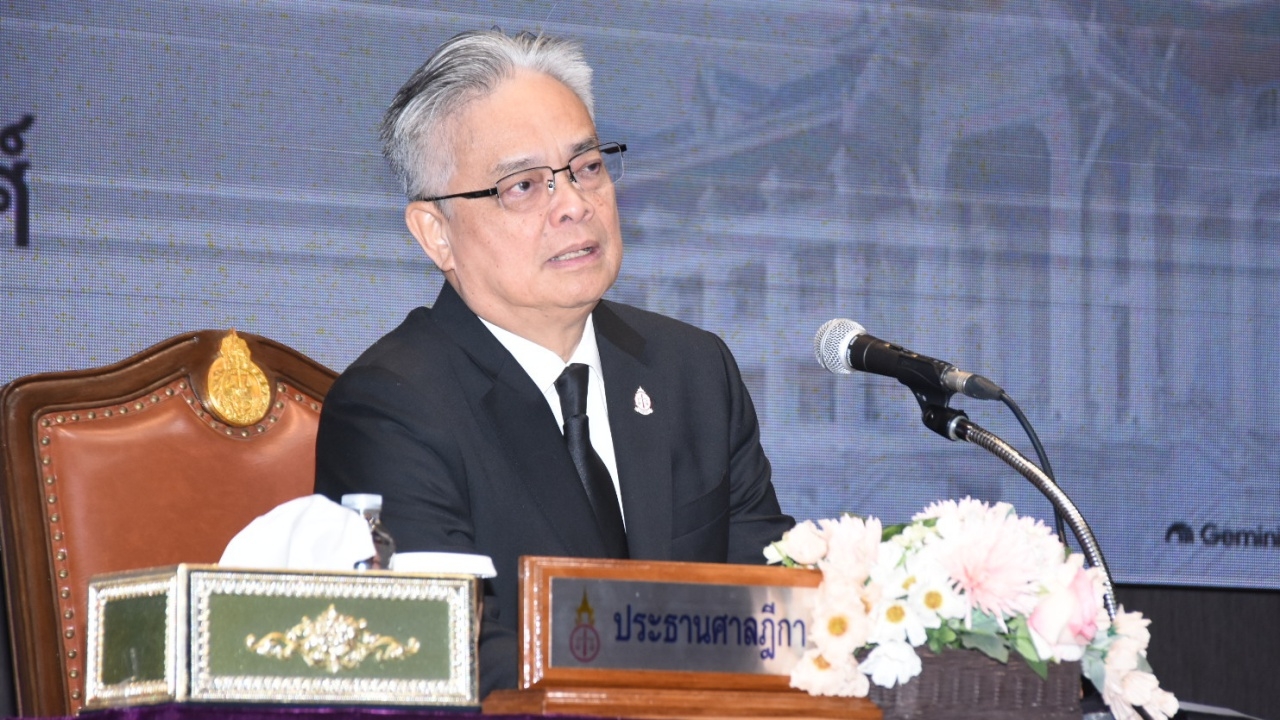
The Chief Justice of the Supreme Court gave a keynote speech at a seminar to gather opinions on revising the standard sentencing guidelines ('Yit Tok'), focusing on making the judiciary an institution that ensures social peace and order.
On 12 Nov 2026 at the Judicial Officials Development Institute building on Ratchadaphisek Road, in the Sanya Thammasak meeting room, Mr. Weeraphong Sudawong, Chief Justice of the Supreme Court, delivered a keynote titled “Some Observations on Gathering Opinions for Revising the Standard Sentencing Guidelines in Major Offenses” during the opening of the 2027 Justice Coordination Promotion Project seminar. The workshop, focused on collecting opinions on revising the standard sentencing guidelines, known as 'Yit Tok,' was well attended by judiciary executives, judges, representatives from justice agencies, related organizations, and experts.
In his keynote, Mr. Weeraphong recounted his experience presiding over various cases to provide examples that informed the development of the revised standard sentencing guidelines for major offenses. Currently, there are five categories under consideration: 1. Drug offenses, technology crime prevention under the 2023 Emergency Decree, and significant election-related offenses; 2. Land traffic violations and related laws; 3. Firearms offenses under the 1947 Firearms, Ammunition, Explosives, Fireworks, and Imitation Firearms Act; 4. Corruption and misconduct cases; and 5. Environmental cases.
During the speech, Mr. Weeraphong stated that the main vision for revising the sentencing guidelines is to guarantee social peace. He emphasized that Thailand’s laws are sound, but the lack of effective enforcement and lenient punishments have hindered crime control. For example, some firearm offenses involve accumulation without clear reasons, raising concerns about unregulated possession and potential misuse. He noted that in his judicial experience, he has never seen cases prosecuting gun owners for unlawfully allowing others to possess their firearms. Firearms have become as casually used as bicycles, despite being lethal weapons.

He further cited a past incident where schools fought, causing innocent villagers to suffer as bystanders during festivals and weddings in provinces, highlighting the risk to life and property in everyday Thai life. He stressed that it is time to act seriously. The revised sentencing guidelines should clearly state the penalties for specified offenses. He believes that sufficiently strict standards will help curb crime, enhancing the safety of citizens’ lives and property. As a judge, he pledged to actively protect society, including cases involving drugs, traffic offenses like drunk driving, environmental crimes, and corruption.
He added that society must be assured that offenders will face appropriate penalties. The judiciary is prepared to support society and will no longer be lenient. Protecting citizens’ rights and freedoms is paramount, and the courts’ responsibility to society will be made concrete. For example, in environmental cases, discussions with the judiciary's secretary-general aim to compile data from all court levels regarding rulings on land restitution to the Department of National Parks and Forestry. This effort assesses progress and efficiency but is not intended to target defendants harshly. These initiatives present challenges for the judiciary to handle cases promptly and diligently according to legal intent. Similarly, in corruption cases, the goal is not only suppression but also balancing anti-corruption efforts with protecting officials’ rights.
In performing their duties, judges must maintain balance to avoid discouragement from counter-lawsuits. There must be an appropriate balance between allowing victims to file lawsuits easily and the court’s duty to verify the sincerity of such claims.

The Chief Justice also noted that the establishment of subcommittees to revise the standard sentencing guidelines aims to promote social peace in the country. He respects the subcommittees’ discretion and expects thorough consideration within each group. The guidelines are not meant to be rigid; judges are accustomed to using standard sentencing guidelines in their courts. When a judge deviates from the guideline, they consult with the court chief judge and document reasons in their rulings. Standards are human-made and thus require flexibility. Judges may exercise discretion, but it must be reasoned and not arbitrary, clearly explaining why their judgment differs from the standard. The current efforts will proceed for the benefit of the nation and society. Good administration requires transparency, and the sentencing guidelines should be publicly announced so citizens understand the penalties they face if they break the law, serving as a deterrent.
Meanwhile, a seminar on revising the sentencing guidelines was held today, including onsite public opinion gathering until 16:30, to collect feedback for the five subcommittees. This input will help establish sentencing standards aligned with stakeholders’ views.
Mr. Suriyan Hongwilai, spokesperson for the judiciary, said that the Chief Justice’s key policy is to have the justice system protect society. The most tangible current initiative is the standard sentencing guidelines, known popularly as 'Yit Tok.' Each court uses these guidelines to help determine penalties, ensuring similar offenses receive comparable punishments. The guidelines do not restrict judges’ discretion but support it. The Chief Justice urges prompt action due to ongoing issues in several case types, including environmental, traffic, drug, firearms, and corruption cases. He wants the courts, as the main sentencing authority, to review whether the sentencing guidelines across courts are consistent and relevant to current societal conditions, and whether they help reduce crime rates. This event is the first time opinions from relevant agencies and the public have been invited to jointly set realistic sentencing standards.

When asked how long it will take to finalize the 'Yit Tok' guidelines, Mr. Suriyan said the five subcommittees will compile the received feedback into a sentencing guideline covering major frequent case types before submitting it to the Chief Justice. The subcommittees have already started and set a timeline aiming for completion before year-end, after which the guidelines will be publicly announced. The goal is to standardize sentencing nationwide, though some flexibility remains for judges to exercise discretion based on local contexts. The subcommittees have noted some differences between regions, though not drastically so.
Asked whether the court’s sentencing standards will influence police and prosecutors during investigations, Mr. Suriyan said that while courts are the final stage in cases, the guidelines aim to impact society broadly, helping address problems at their roots. Clear public announcements of the standards are expected to reduce the initiation of offenses.