

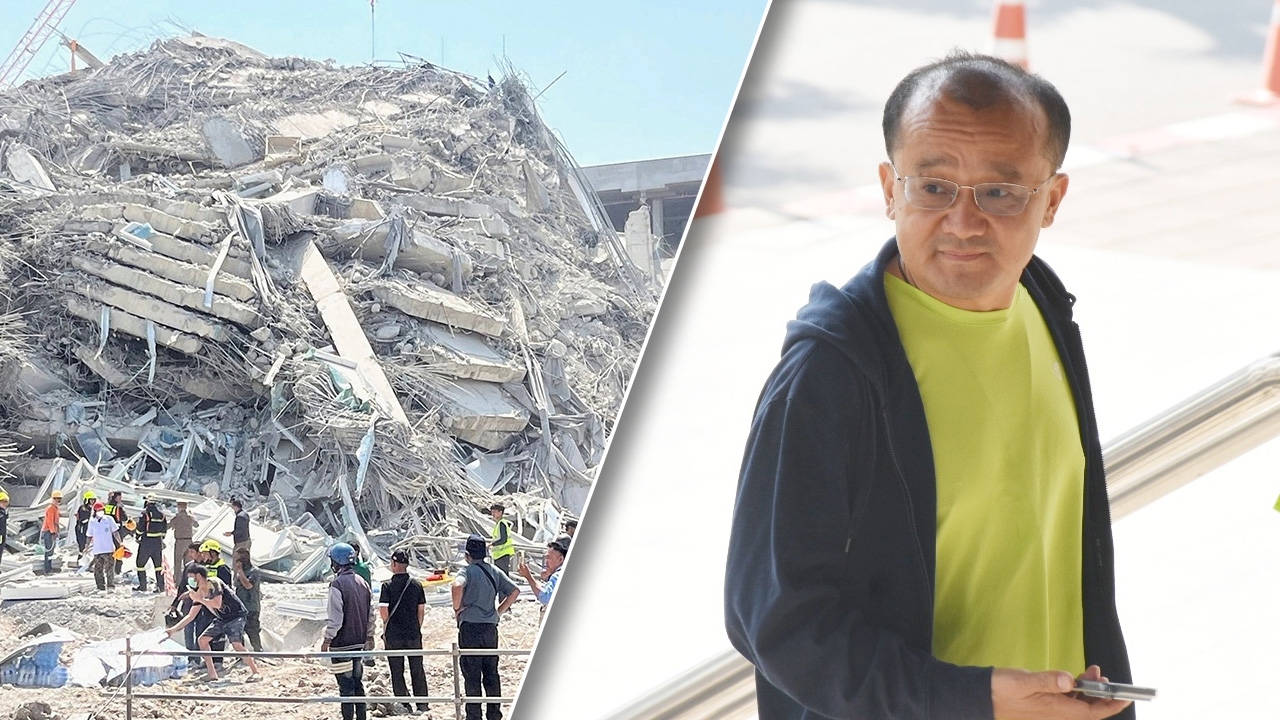
The criminal court sentenced Chuanling Zhang to 3 years in prison and fined 1 million baht for acting as a nominee in constructing the new Office of the Auditor General (OAG) building, which collapsed causing numerous deaths and injuries.
At 10:00 a.m. on 18 Nov 2026 in courtroom 904 of the Criminal Court, the court heard the verdict in the nominee company case involving construction of the OAG building, case number Aor. 1558/2568. The special prosecutor from the Special Case Division 5 filed charges against defendant 1, China Railway Number 10 (Thailand) Co., Ltd., represented by authorized director defendant 2, Chuanling Zhang, a Chinese national. Defendants 3 to 5 are Thai nationals—Sophon Meechai (director and shareholder), Prajuab Sirikhet (shareholder), and Manas Sri-anant (director and shareholder)—accused of acting as directors, partners, or authorized representatives of the legal entity who knowingly consented to Thai nationals committing offenses, or failed to properly prevent such offenses, aiding foreigners to circumvent or violate the Foreign Business Act by conducting business without permission.
This case involves a nominee company building the new 33-story Office of the Auditor General (OAG) headquarters that collapsed on the afternoon of 28 March 2025, causing many deaths and injuries. The defendants denied the charges and were granted bail. The court ordered probation officers to investigate and report on the defendants for consideration in the judgment.
The judgment states the uncontested facts: defendant company 1 has registered capital of 100 million baht. Defendant 2 was the managing director as of 26 Oct 2018 when the company joined the joint venture to construct the new OAG building. On 28 Mar 2025, the OAG building collapsed, and defendant 2 was arrested on 19 Apr 2025. During witness testimony, defendants 3, 4, and 5 changed their pleas to guilty, while defendants 1 and 2 maintained denial.
The first issue is whether defendant 1 violated the Foreign Business Act B.E. 2542 by conducting construction business. The court found the company's purpose was to engage in construction of buildings, offices, drainage systems, railways, bridges, trams, subways, and consultancy for construction bids, clearly showing continuous construction activity. Despite defendant 1's claim of not having construction contracts after the building collapse, the court concluded the company did engage in construction business.
The next issue is whether defendant 1 violated the Foreign Business Act. Investigation by the Department of Special Investigation found that defendant 2 was the sole managing director with authority in defendant company 1, and evidence showed defendants 3-5 held shares on behalf of foreigners in a disguised manner. Defendant 1 is owned by China Railway Number 10, a foreign company, thus making defendant 1 a foreign-owned entity. Foreigners are prohibited from conducting construction business under the law.
The court considered whether defendant 2 was guilty as charged. Defendant 2 became managing director of defendant 1 on 20 Oct 2018 and signed contracts for the joint venture with Italian-Thai Development for constructing the new OAG building. Defendant 2 signed financial statements and construction contracts, exercising sole authority until the building collapse in 2025.
The court found defendants 1-5 should be punished. Defendant 1 circumvented the law by continuously bidding on state construction projects over several years. Defendants 3-5, as Thai citizens, facilitated benefits to foreigners. Their actions were significant in committing the offenses, motivated by personal gain, and were blameworthy because their misconduct caused damage and was unfair to other Thai businesses. Allowing this conduct as normal would harm the country and other construction businesses. Although defendants 2-5 had no prior offenses, their repeated violations show they were not previously well-behaved. Defendant 2's compensation to victims’ families did not mitigate the gravity of losses. Defendants 3-5 pleaded guilty in court to seek leniency, but the court imposed heavy sentences to demonstrate such behavior is unacceptable.
The court ruled defendant 1 guilty under the Foreign Business Act B.E. 2542 and fined 1 million baht. Defendant 2 was found guilty under sections 41 and 47 of the Act, sentenced to 3 years imprisonment and fined 1 million baht. Defendants 3 and 5 were guilty under sections 36 and 41 for holding shares on behalf of foreigners, sentenced to 3 years imprisonment and fined 1 million baht each, also guilty as directors representing foreigners with the same sentence and fine. Defendant 4 was guilty under section 36 for holding shares on behalf of foreigners, sentenced to 3 years imprisonment and fined 1 million baht.
Defendants 3-5 received a one-fifth sentence reduction for guilty pleas, resulting in defendants 3 and 5 sentenced to 4 years, 9 months, and 18 days in prison and fined 1.6 million baht each. Defendant 4 was sentenced to 2 years, 4 months, and 24 days imprisonment and fined 800,000 baht. The court ordered defendant company 1 to dissolve as charged, defendants 3-5 to cease assisting or holding shares in defendant company 1, and to count defendant 4's sentence consecutively with a previous 3-year sentence from the Central Criminal Court for Corruption and Misconduct Cases.
Reporters noted that the main case regarding the construction of the OAG building, filed by the Criminal Division 8 prosecutor against former Italian-Thai Development CEO Premchai Kransut and others, is still in evidence hearing at the Criminal Court.